

Does Specialized Travel Gear Reduce Fatigue? A 2026 Guide
Table of Contents
- What You'll Need Before You Start
- Step 1: Understand How Travel Gear Reduces Fatigue
- Step 2: Choose Ergonomic Travel Accessories for Long Flights
- Step 3: Learn How to Reduce Muscle Fatigue While Traveling
- Step 4: Explore the Benefits of Compression Socks for Travel
- Step 5: Pack Gear That Protects Your Body and Your Equipment
- Common Mistakes to Avoid When Buying Travel Gear
- Conclusion
- Frequently Asked Questions
Last Updated: October 1, 2026
What You'll Need Before You Start
You don't need much to test whether travel gear actually helps, or to answer does specialized travel gear reduce fatigue. You need a long trip, a few key items, and a way to tell the difference between "I'm tired" and "my body is worn down."
That second part matters more than most people think.
Fatigue during travel is the combined result of poor circulation, fixed posture, dehydration, cabin pressure, and mental overload. Each one chips away at you. Together, they leave you wrecked after a flight that "wasn't even that long."
This guide from Journey Must Haves walks through what actually works. We'll cover compression, ergonomics, and the gear that earns its place in your bag.
Here's your starting kit:
- A pair of graduated compression socks
- A neck pillow or lumbar support
- Loose layers you can adjust
- Water, and plenty of it
- A plan for moving every hour or two
That's it. No gadgets required.
Step 1: Understand How Travel Gear Reduces Fatigue
Specialized travel gear reduces fatigue by supporting circulation, posture, and recovery while you sit still for hours. It doesn't make you immune to tiredness. It removes some of the physical causes.
The biggest one is blood flow.
When you sit for long stretches, blood pools in your lower legs. Your muscles aren't contracting, so they aren't pushing blood back toward your heart. That's where venous return comes in, and it's the process compression gear is designed to support.
Cabin pressure adds another layer. The FAA cabin pressurization guidance explains that cabins are pressurized to an altitude equivalent, not sea level, which is why some travelers feel swollen and drained.
So the real question isn't whether gear helps. It's which gear targets which problem.
| Problem | What Helps | Why It Works |
|---|---|---|
| Blood pooling | Compression socks | Supports venous return |
| Neck and back strain | Support pillows | Keeps spine aligned |
| Stiff muscles | Movement breaks | Restarts circulation |
| Swelling | Elevation, hydration | Reduces fluid buildup |
Step 2: Choose Ergonomic Travel Accessories for Long Flights
Start with the items that change your posture, not the ones that just feel nice. A neck pillow that keeps your head upright prevents more soreness than any gadget that vibrates.
The reason is mechanical. When you sit for hours, your head drifts forward, your cervical spine loses its natural curve, and the muscles at the base of your skull stay contracted to hold your head up. That sustained contraction is what produces the dull headache and stiff neck that show up around hour three. A support pillow works by giving your head something to rest against so those muscles can release. A pillow that doesn't hold neutral alignment just changes which muscles get tired.
For families, the calculus shifts. You're not just managing your own comfort; you're managing a child's.

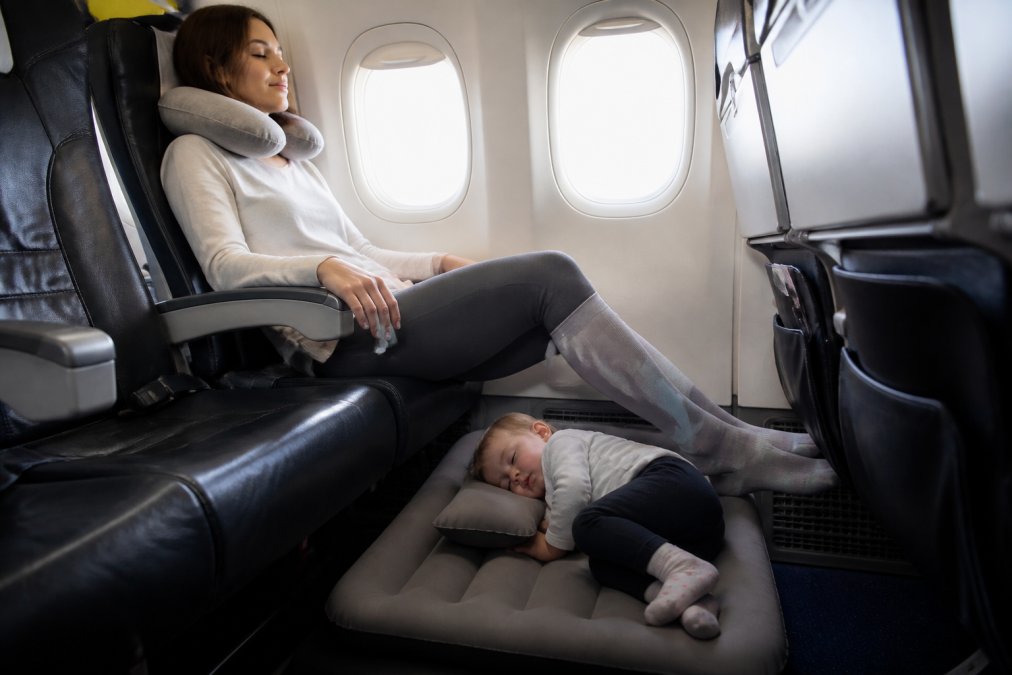
What actually earns space in your carry-on:
- Support pillow that holds your neck in neutral position, look for one with a firm core, not loose fill that collapses under head weight
- Lumbar roll for lower back support on long hauls, a rolled jacket works in a pinch, but a shaped roll holds its position better
- Compression socks for circulation
- Eye mask and earplugs to reduce sensory load
- Aisle seat when you can get one, so you can move
The ergonomic travel accessories for long flights that matter most are the ones you'll actually use. A pillow you have to inflate with effort won't get used at hour six. That's a real trade-off: inflatable pillows pack small but require breath and effort to deploy, while memory foam holds its shape but eats carry-on space. If you fly often, a hybrid design with a firm foam core and a compressible shell tends to win.
Material matters here too.
SUV Car Air Mattress – Foldable Back →
Step 3: Learn How to Reduce Muscle Fatigue While Traveling
The single best way to reduce muscle fatigue while traveling is to move before your body stiffens, not after. Set a timer. Get up. Walk the aisle.
Here's a simple routine that takes two minutes:
- Stand and shift weight side to side, 30 seconds
- Roll your ankles in circles, 10 each direction
- Squeeze and release your calves, 15 reps
- Roll your shoulders back, 10 reps
- Stretch your neck gently side to side
Do this every 90 minutes.
Step 4: Explore the Benefits of Compression Socks for Travel
The benefits of compression socks for travel come down to one mechanism, and they show why does specialized travel gear reduce fatigue has a real answer: graduated pressure. The sock is tightest at the ankle and looser toward the calf, which helps push blood upward instead of letting it pool.
What to look for:
- Graduated compression, not uniform tightness, uniform pressure can restrict flow instead of supporting it
- A snug but not painful fit at the ankle
- Breathable fabric so you don't overheat, moisture-wicking blends dry faster and stay comfortable for longer wear
- A size that matches your calf measurement, not your shoe size
- A pressure rating suited to travel, mild to moderate ranges are the common choice for long flights; higher medical-grade pressure is a conversation for your doctor, not a packing list
Keep the Compression Working
Compression fabric is engineered, not permanent. The elastic fibers that create graduated pressure break down over time, and most people never notice until the socks stop helping. A few habits extend their useful life:
- Wash in cool water and skip the fabric softener, which coats fibers and reduces stretch
- Air dry or tumble on low, high heat is the fastest way to kill elastic
- Rotate between two or three pairs so each one recovers between wears
- Replace when the sock no longer feels snug at the ankle or slides down during wear
Step 5: Pack Gear That Protects Your Body and Your Equipment
Gear should do two jobs: protect your body and protect the things you're carrying. Most people only think about the first.
A few items that pull double duty:
- Kids' noise-cancelling headphones to cut engine noise and help little ones sleep
- An inflatable travel bed so a child has a real surface to rest on
- A car air mattress that turns the back seat into a bed on road trips
- A self-warming food warmer so mealtimes don't fall apart mid-journey
Common Mistakes to Avoid When Buying Travel Gear
The biggest mistake is buying gear for the trip you imagine, not the trip you're taking. A neck pillow for a two-hour flight is clutter. For a red-eye, it's essential.

Other mistakes that cost people money:
- Buying compression by shoe size instead of calf measurement
- Skipping movement breaks because the gear "should handle it"
- Overpacking gadgets you'll never inflate or charge
- Ignoring material and care so gear wears out after one trip
- Assuming one item fixes everything
Conclusion
Travel fatigue is real, and it has physical causes you can actually address. Compression, posture support, movement, and the right gear for your family's needs all chip away at it.
Frequently Asked Questions
Do compression socks make you feel less tired during long flights?
Yes, compression socks can reduce feelings of tiredness by supporting venous return and limiting blood pooling in the lower legs. Graduated pressure helps your circulatory system move blood back toward the heart, which can ease heaviness and swelling during long periods of sitting. Many travelers report less leg fatigue after flights when they wear properly fitted compression socks. Pair them with periodic ankle circles and short walks to the galley when the seatbelt sign is off for the best results.
How can ergonomic travel accessories help reduce muscle fatigue?
Ergonomic travel accessories for long flights support your body in neutral positions, which reduces the static muscle tension that builds during hours of sitting. A lumbar cushion maintains the spine's natural curve, a footrest elevates the legs to improve circulation, and a supportive neck pillow prevents the head from drooping. Together these small adjustments lower the effort your muscles expend to hold you upright, so you arrive with less soreness and stiffness.
What are the downsides of wearing compression gear for travel?
Compression gear can feel tight, cause skin irritation if sizing is wrong, or be difficult to put on for people with limited hand strength. Some users find them warm in hot climates. The key is choosing the correct size based on calf and ankle measurements, not shoe size, and taking them off if you feel numbness or tingling. People with peripheral artery disease or severe neuropathy should check with a doctor before using compression socks.
Does specialized travel gear actually prevent jet lag?
Specialized travel gear does not prevent jet lag, which is driven by circadian rhythm disruption across time zones. However, gear that improves sleep quality and reduces physical fatigue can make jet lag feel less severe. For example, noise-cancelling headphones help you sleep on the plane, and a comfortable travel bed for toddlers keeps young children rested so the whole family adjusts faster. Treat gear as a support tool, not a jet lag cure.
This article is for general information only and is not medical advice. If you have a circulation condition, recent surgery, or other health concerns, talk with a healthcare provider before using compression gear or traveling long distances.