

Ergonomic Travel Accessories for Long Trips in 2026
Table of Contents
- Why Standard Travel Gear Fails on Long Trips
- Quick Comparison: Top Ergonomic Travel Accessories
- The Ergonomic Memory Foam Seat Cushion: Your First Defense Against Back Pain
- Can You Bring a Seat Cushion on a Plane? TSA Rules Explained
- How to Prevent Back Pain on Long Flights with Support Layers
- Portable Footrest for Airplane: Why Leg Support Matters
- Compression Socks and Circulation: A Non-Negotiable for Long-Haul
- Neck and Shoulder Relief: Beyond the Basic Travel Pillow
- Frequently Asked Questions
Last Updated: September 7, 2026
Why Standard Travel Gear Fails on Long Trips
Most travel accessories are designed for convenience, not for the human body enduring hours of restricted movement. The ergonomic travel accessories for long trips that actually work address a fundamental problem: standard airplane seats force your spine into a static, unsupported position that leads to joint stiffness and travel fatigue.
At Journey Must Haves, we focus on gear that supports your body's physiological needs during travel, not just items that look good in a carry-on. The difference between arriving refreshed versus arriving sore can come down to understanding how factors like restricted circulation and poor posture compound over a long journey.
Standard neck pillows often push your head forward instead of supporting cervical support. Generic seat cushions flatten under pressure, offering no lumbar alignment.
Quick Comparison: Top Ergonomic Travel Accessories
Ergonomic travel accessories for long trips fall into distinct categories based on what part of your body needs support. The table below summarizes the core options available, what they address, and their typical price points from Journey Must Haves.
| Accessory | Primary Benefit | Price | Best For |
|---|---|---|---|
| Ergonomic Memory Foam Seat Cushion | Lumbar and spinal support | $64.99 | Back pain prevention |
| Calf Compression Socks | Blood circulation | $27.99 | Swelling and DVT prevention |
| Plus Size Compression Socks | Circulation, extended sizes | $26.99 | 2XL to 7XL sizing |
| USB Heated Shoulder Wrap | Muscle tension relief | $51.42 | Neck and shoulder stiffness |
| Cervical Traction Device | Post-flight neck recovery | $44.13 | Chronic neck tension |
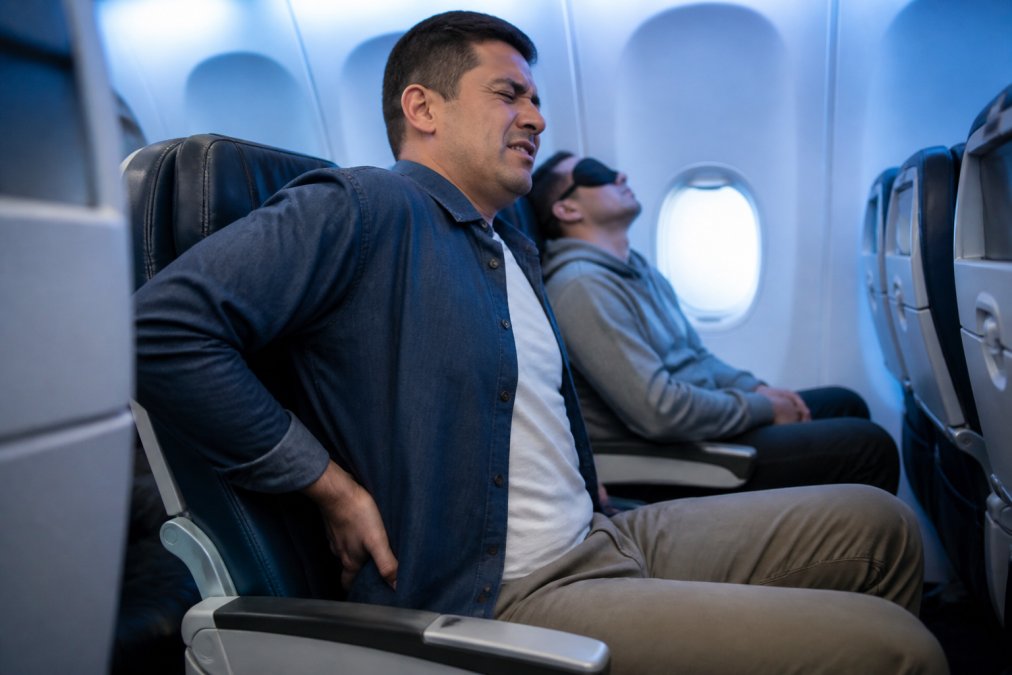
The Ergonomic Memory Foam Seat Cushion: Your First Defense Against Back Pain
The ergonomic memory foam seat cushion can be a valuable investment for supporting comfort on long trips. A quality cushion uses slow-rebound memory foam that conforms to your weight distribution. The Journey Must Haves option features a breathable mesh cover and measures 46 by 43 by 12 centimeters.

Cushion density matters more than thickness. A low-density cushion feels soft initially but compresses completely within an hour. The ergonomic design distributes your weight evenly, reducing pressure points on the tailbone and hips.
Can You Bring a Seat Cushion on a Plane? TSA Rules Explained
Yes, you can bring a seat cushion on a plane, and the rules are straightforward. According to TSA guidelines on carry-on items, seat cushions are permitted through security checkpoints as carry-on items. The key consideration is whether the cushion fits within your airline's carry-on compliance requirements for the overhead bin or under-seat storage.
Memory foam cushions compress significantly under vacuum or tight packing, making them easier to fit than rigid alternatives. Many travelers prefer to use the cushion on the plane rather than storing it. If you're concerned about space, consider a cushion with a compression strap.
Why the Seat Type Changes Your Cushion Choice
The ergonomic benefit of a cushion depends entirely on the seat you're sitting in. A cushion that works well in a wide-body aircraft seat with a 17.2-inch width may be useless in a narrow-body regional jet with a 16.1-inch width. The cushion's footprint must match the seat pan's dimensions.
With limited seat pitch (30 to 32 inches on most domestic carriers), a thick cushion that raises your hips by 3 inches can push your knees into the seat back. That forces you into a slouched position, undoing the lumbar alignment. Look for cushions with a tapered front edge or a wedge profile that tilts your pelvis without adding excessive height.
The Biomechanics of a Wedge vs. a Flat Cushion
A flat memory foam cushion distributes pressure evenly, which helps with tailbone pain. But a wedge-shaped cushion rotates your pelvis anteriorly by roughly 10 to 15 degrees, restoring the natural lordotic curve in your lower spine. Some ergonomic principles suggest a wedge angle in this range for travel.
If you have a history of herniated discs or sciatica, a flat cushion with a cutout for the tailbone may be safer than a wedge. Match the shape to your seat dimensions and your specific back condition.
How to Prevent Back Pain on Long Flights with Support Layers
Preventing back pain on long flights requires a layered approach. Think of your seat setup as a support system with three zones: lumbar, pelvic, and cervical. The ergonomic seat cushion handles the pelvic zone by tilting your hips forward. For lumbar alignment, roll a small travel pillow or folded jacket and place it in the curve of your lower back.
The third layer addresses your neck. A properly designed neck pillow should cradle the back of your neck while allowing your head to rest naturally, not jut forward toward your tray table.
- Pelvic zone: Seat cushion to tilt hips and reduce tailbone pressure
- Lumbar zone: Rolled support to maintain the natural curve of your lower spine
- Cervical zone: Neck support that keeps your head aligned over your shoulders
Portable Footrest for Airplane: Why Leg Support Matters
A portable footrest for airplane travel addresses a problem most travelers don't anticipate: leg length. When your feet dangle unsupported, it pulls on your hamstrings and lower back. A footrest elevates your legs slightly, reducing pressure on the backs of your thighs and improving blood circulation.
A bulky footrest that adds significant weight to your carry-on defeats its purpose. Look for inflatable options that pack flat or lightweight designs that tuck into the seat pocket. The goal is to create a slight bend at the knee, which takes tension off your lower spine.
If a dedicated footrest isn't feasible, your own carry-on bag positioned under the seat in front can serve a similar function. Your feet should rest on something, not hang in the air.
The Weight-to-Comfort Ratio: A Practical Framework
The average carry-on weight limit on domestic carriers is 35 pounds (transportation.gov). Every ounce you spend on a footrest is an ounce you can't spend on a seat cushion, compression socks, or a neck support device. That's why you need a weight-to-comfort ratio analysis before you buy.

A typical inflatable footrest weighs 8 to 12 ounces and provides roughly 6 inches of elevation, about 1.5 to 2 ounces per inch. A hardshell footrest weighs 1.5 to 2.5 pounds and provides 4 to 5 inches of elevation, roughly 5 to 8 ounces per inch. The inflatable option delivers more elevation per ounce but can lose air slowly over a 6-hour flight.
The Trade-Off: Stability vs. Packability
Inflatable footrests win on weight and packability, but they shift when you shift. Hardshell footrests stay put because their weight anchors them, but they're rigid and can't conform to the cramped space under the seat.
A middle-ground option is a softshell footrest with a weighted base or a non-slip bottom. These typically weigh 1 to 1.5 pounds and offer a stable platform without the bulk of a hardshell.
The Angle That Actually Matters
Your knee angle is the key variable. When your feet dangle, your knees are at roughly 90 degrees, which pulls on your hamstrings and flattens your lumbar spine. Elevating your feet by 4 to 6 inches opens your knee angle to about 110 to 120 degrees, reducing tension on the sciatic nerve.
If you're under 5 feet 4 inches tall, your feet will almost certainly dangle in a standard economy seat, so a footrest is a necessity. If you're over 6 feet tall, a footrest may not fit at all; a foot hammock that attaches to the tray table latch is a better option.
The Carry-On Bag Alternative
Your own carry-on bag can serve as a makeshift footrest, but only if it's packed correctly. A soft-sided bag filled with clothing provides a stable, slightly compressible surface. Hard-sided luggage offers no give and can create a pressure point on your heels. Place the bag so the flat side faces up and your feet rest on the widest surface.
Compression Socks and Circulation: A Non-Negotiable for Long-Haul
Compression socks are a widely recognized ergonomic travel accessory for long trips. Their graduated compression design improves blood circulation and reduces muscle fatigue during prolonged sitting. The Journey Must Haves calf compression socks provide targeted pressure with moisture-wicking fabric.
What distinguishes quality compression wear is the fit. Socks that are too loose offer no benefit; socks that are too tight restrict circulation. Sizing should be based on your calf circumference, not just shoe size. Journey Must Haves offers both standard and plus size compression socks ranging from 2XL to 7XL.

CDC guidance on preventing blood clots during travel recommends moving your legs regularly and considering compression wear for long trips. The anti-slip design keeps the socks in place during movement, reducing friction and irritation while you shift in your seat or walk the aisle.
Neck and Shoulder Relief: Beyond the Basic Travel Pillow
The basic U-shaped travel pillow often supports the sides of your neck but may leave the cervical spine unsupported. Ergonomic travel accessories for long trips that address neck relief focus on the base of the skull and the upper trapezius muscles. The cervical traction device from Journey Must Haves targets the GB20 acupuncture points below the occiput.
For travelers who carry tension in their shoulders, the USB heated shoulder support wrap combines vibration with soothing heat to ease tension. Its dual-mode design targets the shoulder and neck simultaneously.
The key difference between recovery tools and comfort items is engagement. A pillow is passive; it holds your neck in whatever position you place it. A traction device or heated wrap actively works on muscle tissue, releasing tension that builds during hours of static posture.
Long flights challenge your body in ways that standard travel gear fails to address. By choosing ergonomic travel accessories that support spinal alignment, blood circulation, and muscle recovery, you can arrive ready to explore rather than needing a recovery day. Journey Must Haves curates gear specifically for travelers who need real support. Explore Our Collections and build a travel kit that supports your body on every journey.
Frequently Asked Questions
Can you bring a seat cushion on a plane?
Yes, you can bring a seat cushion on a plane. The TSA does not prohibit them, and they are generally allowed as a carry-on item or personal item. To speed up security screening, remove the cushion from your bag and place it in a bin for X-ray screening. If your cushion has a built-in battery for heating or massage functions, check with your airline first, as battery-powered devices may have specific restrictions.
How do I choose the right ergonomic travel accessories for my specific needs?
Start by identifying your pain points. If you have lower back issues, prioritize a high-density memory foam seat cushion like the Ergonomic Memory Foam Seat Cushion. For leg swelling or circulation concerns, graduated compression socks are essential. If neck stiffness is your main issue, look for a cervical support device that provides traction. Consider your weight and body type, as some cushions are firmer and more supportive for heavier individuals.
Are footrests allowed as carry-on items for air travel?
Yes, portable footrests are allowed as carry-on items, provided they fit within your airline's carry-on size restrictions. Most airlines require carry-on bags to be under 22 x 14 x 9 inches. While an inflatable footrest can be packed easily, a rigid one may need to be attached to your bag or checked. Always verify the dimensions with your specific airline to avoid issues at the gate.
What is the difference between regular compression socks and plus-size compression socks?
The primary difference is the sizing range and fit. Regular compression socks often have a smaller calf circumference and may feel too tight for individuals with larger legs. Plus-size compression socks, like the Plus Size Compression Socks for Sports and Fitness, are designed with higher elasticity and extended sizes (up to 7XL) to provide the correct graduated pressure without cutting off circulation. This ensures you get the deep vein thrombosis prevention benefits without discomfort.