

Travel Seat Cushions for Chronic Back Pain: A Buyer's Guide
Table of Contents
- Why a Dedicated Travel Seat Cushion Matters for Chronic Pain
- Key Features to Prioritize in Travel Seat Cushions
- Finding the Best Travel Seat Cushion for Sciatica Relief
- Choosing an Ergonomic Seat Cushion for Airplane Seats
- How to Pack a Seat Cushion for Travel Without the Bulk
- Common Mistakes to Avoid When Traveling with a Cushion
- Conclusion: Protecting Your Back on Every Journey
- Frequently Asked Questions
Last Updated: September 8, 2026
Why a Dedicated Travel Seat Cushion Matters for Chronic Pain
Standard airline seats, bus benches, and car seats are engineered for the average body, not for one managing chronic back pain. Sitting for hours on a rigid surface presses the ischial tuberosities into the seat base, aggravating the coccyx and triggering spinal spasms.
Travel seat cushions for chronic back pain redistribute weight away from the tailbone and support the lower spine's natural curve. Unlike thin airport foam pads, a dedicated cushion maintains density over a six-hour flight, preventing the "bottoming out" that leaves you sore within the first hour.
Key Features to Prioritize in Travel Seat Cushions
A common mistake is choosing a cushion based on softness. Plush materials compress fully under load, leaving your tailbone where it started. The priority order for chronic pain is: pressure relief, spinal alignment, then portability.
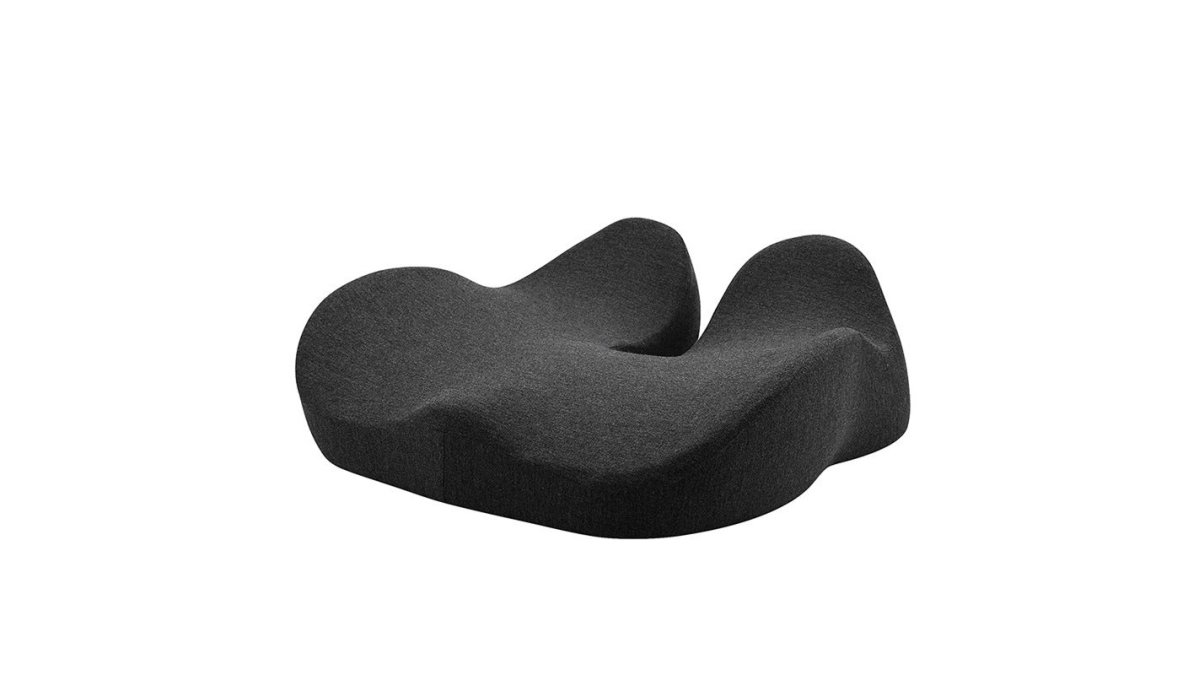
Look for a cut-out or U-shaped channel at the rear to remove pressure from the coccyx entirely, critical for tailbone pain or post-surgical sensitivity. The front edge should slope downward to reduce pressure behind the knees and support circulation during long-haul travel.
The cover matters more than most buyers realize. A breathable mesh cover prevents heat buildup, while a non-slip base keeps the cushion from sliding on leather or vinyl seats. Washable covers are a practical necessity, not a luxury.
Memory Foam vs. Gel: Which Relieves Pressure Best?
Memory foam and gel take different approaches to the same problem. High-density memory foam conforms slowly to your body shape, distributing weight across the largest possible surface area and maintaining neutral spine alignment.
Gel cushions displace fluid under pressure, providing a firmer, more stable surface that manages temperature better than traditional foam. For travelers who run warm, gel-infused options combine foam support with cooling properties.
Size, Density, and the Non-Slip Base
Density is measured in pounds per cubic foot, and higher density translates directly to longer durability. A low-density foam cushion may feel comfortable initially but will lose its rebound within months.
The non-slip base is the most underrated feature on the market. Without it, the cushion shifts forward every time you adjust position, forcing you to re-align your posture and introducing new muscle tension.
Finding the Best Travel Seat Cushion for Sciatica Relief
Sciatica pain originates from compression or irritation of the sciatic nerve, which runs from the lower back through the hips and down each leg. For this condition, the best travel seat cushion for sciatica focuses on reducing pressure at the piriformis muscle and maintaining a neutral pelvic position.

The key for sciatica is a firm, contoured surface that prevents the pelvis from tilting backward. A posterior pelvic tilt collapses the lumbar curve and compresses the nerve root. A wedge-style cushion that raises the hips slightly can help maintain the natural inward curve.
Travelers with sciatica should also consider cushion height. Too thin fails to provide adequate lift; too thick raises your knees above your hips, shifting pressure forward onto the thighs. Aim for a cushion around 3 inches thick at the rear, tapering to about 2 inches at the front.
Why Sciatica Requires a Different Cushion Profile
Sciatica is not a single condition but a symptom of underlying nerve compression, often stemming from a herniated disc, spinal stenosis, or piriformis syndrome. Each cause responds differently to seat support:
- Herniated disc-related sciatica often worsens with forward flexion of the spine. A cushion that maintains a slight lumbar lordosis, the inward curve of the lower back, reduces intradiscal pressure. A wedge with a built-in lumbar support block is often more effective than a flat contour cushion.
- Piriformis syndrome involves the piriformis muscle pressing on the sciatic nerve deep in the buttock. A U-shaped or cut-out cushion that removes pressure from the ischial tuberosities allows the piriformis to relax, reducing nerve irritation. Full-contact cushions, even ergonomic ones, can aggravate this condition.
- Spinal stenosis often improves with slight forward leaning, which opens the spinal canal. A mild wedge that tilts the pelvis forward by 10 to 15 degrees can provide relief, but the same wedge may worsen a herniated disc. This is why a single "sciatica cushion" recommendation is misleading.
Positioning and Micro-Adjustments During the Flight
Even the best cushion fails if you sit statically for six hours. The sciatic nerve responds poorly to sustained compression, so shift your weight slightly every 20 to 30 minutes, a small forward lean, a lateral shift, or a brief stand in the aisle if the seatbelt sign is off.
A non-slip base is non-negotiable for sciatica. Without it, the wedge slides forward during turbulence, and the resulting pelvic shift can reintroduce nerve compression within minutes. Look for a high-friction silicone or rubber lattice rather than a simple PVC backing.
Material Choice: Firm Foam vs. Gel for Nerve Pain
For sciatica, material density matters more than surface softness. A low-density foam that compresses by more than 40 percent under your sitting weight will allow the pelvis to sink unevenly, tilting the sacrum and aggravating the nerve root. High-density polyurethane foam, typically rated at 2.5 to 3.0 pounds per cubic foot, provides the stable platform needed to keep the pelvis level.
Gel cushions displace laterally under load, which can reduce peak pressure at the sciatic notch, but they are heavier and can feel unstable during lateral movements. A hybrid design, a high-density foam core with a thin gel top layer, often provides the best balance for nerve-related pain.
Testing Your Cushion Before a Long Trip
Do not debut a new cushion on a transcontinental flight. Test it at home for at least two consecutive hours of seated work. If you feel increased tingling or numbness in the first 30 minutes, the cushion profile is wrong for your specific nerve involvement. A cushion that feels comfortable for the first hour but causes referred pain by hour two is bottoming out or misaligned.
Measure your sitting width before purchasing. The distance between your ischial tuberosities typically ranges from 4 to 6 inches, and the cushion's central channel or cut-out must be wider than this distance to be effective. A channel that is too narrow will straddle the tuberosities and concentrate pressure where the sciatic nerve passes.
Choosing an Ergonomic Seat Cushion for Airplane Seats
Airplane seats present a unique challenge: they are narrow, thinly padded, and recline only a few degrees. An ergonomic seat cushion for airplane seats must therefore be compact enough to fit within the seat dimensions while still providing adequate support.
The width of the cushion should match the airline seat, typically 17 to 18 inches. Too wide will curl up at the edges, reducing its effective surface area. Too narrow fails to support the full length of your thighs.
The cushion should also be firm enough to resist the hard plastic seat base beneath the thin foam padding. Many travelers find that a high-density foam cushion provides better support on airplanes than on car seats, because the underlying surface is so unforgiving.
Temperature Regulation in Cramped Economy Seats
One of the most overlooked factors in long-haul travel is heat buildup. Economy cabin temperatures are typically maintained between 22 and 24 degrees Celsius (72 to 75 degrees Fahrenheit), but body heat trapped between your back, the seat, and a dense foam cushion can raise local skin temperature by several degrees within the first hour (the CDC). This is not merely a comfort issue, sustained heat accelerates skin breakdown and increases sweating that can lead to chafing.
Traditional memory foam is the worst offender. Its closed-cell structure traps heat and resists air circulation. A standard polyurethane foam cushion can feel noticeably warm by hour two, and by hour five, moisture buildup can compromise the cushion's grip on the seat.
Gel-infused foams incorporate phase-change materials that absorb heat as they melt, but they have a finite capacity. After two to three hours, the gel reaches body temperature and stops providing active cooling. Open-cell foams with a channeled or honeycomb structure allow passive air movement, which is more sustainable over a long flight.
For travelers who consistently run warm, consider a cushion with a breathable 3D mesh cover rather than a polyester or velvet cover. The mesh allows air to circulate between your body and the foam, and it dries quickly if you perspire. Some premium covers use a spacer fabric construction, two layers of mesh separated by monofilament fibers, which creates a permanent air gap that reduces contact surface area by up to 40 percent.
Post-Surgery Recovery Travel Protocols
Traveling after spinal or hip surgery introduces constraints that standard ergonomic advice does not address. Most surgeons recommend avoiding prolonged sitting for the first two to four weeks post-operatively, but when travel is unavoidable, for follow-up appointments, family obligations, or returning home after a procedure, the cushion becomes part of a broader medical protocol.
If you are recovering from coccygectomy, lumbar fusion, or total hip replacement, a standard U-shaped cushion may be insufficient. Post-surgical patients often require a cushion with a deeper, wider cut-out that completely eliminates contact with the surgical site, not merely reduces pressure. Look for a cut-out depth of at least 2 inches and a channel width of 4 inches or more.
For hip replacement patients, the primary concern is maintaining the hip at an angle greater than 90 degrees to prevent dislocation. A standard cushion that raises the hips may inadvertently flex the hip joint beyond the safe range. A wedge cushion with a gradual slope, no more than 15 degrees, is generally safer than a thick contour cushion.
Post-surgical travelers should also plan for the security screening process. Inform the TSA officer that the cushion is medically necessary and that you have a recent surgical incision. You may be asked to undergo additional screening, and the cushion will likely be swabbed for explosive residue. Allow an extra 10 to 15 minutes at security if you are traveling within six weeks of surgery.
The 50-Hour Durability Test
Most cushion reviews are first impressions, a product feels supportive in the store or during a short test sit, and the reviewer declares it excellent. The reality of chronic pain management is that a cushion must perform consistently across dozens of flights, not just one.
A high-density foam cushion rated at 2.8 to 3.0 pounds per cubic foot should retain at least 90 percent of its original thickness after 50 hours of seated use. Lower-density foams, typically rated below 2.0 pounds, may lose 15 to 20 percent of their thickness within the same period, translating to a noticeable reduction in pressure relief.
To test durability at home, sit on the cushion for two hours daily for two weeks and measure its thickness with a ruler before and after. A loss of more than 3 millimeters indicates the foam is breaking down prematurely. Also inspect the cover seams, a cover that pills or frays after 20 hours of use will not survive a year of frequent travel.
Compatibility with Airline Seat Dimensions
Beyond the standard 17 to 18 inch seat width, consider the seat pitch, the distance between your seat and the one in front of you. On many domestic economy configurations, seat pitch is 30 to 31 inches, which limits how far you can recline and how much legroom you have to adjust your position. A cushion that is too thick at the front can raise your knees into the seatback pocket in front of you, creating an uncomfortable posture that negates the cushion's benefits.
Measure the seat depth as well. Most economy seats have a depth of 17 to 18 inches from the backrest to the front edge. A cushion that extends beyond the seat edge will press into the back of your knees, restricting circulation. Choose a cushion with a depth of 16 to 17 inches, and verify that the front edge slopes downward rather than terminating abruptly.
For travelers who fly on multiple airlines with varying seat dimensions, a cushion with a tapered profile, narrower at the front than at the rear, offers the best compatibility. This shape accommodates both the narrower seats of regional jets and the wider seats of long-haul wide-body aircraft.
How to Pack a Seat Cushion for Travel Without the Bulk
Learning how to pack a seat cushion for travel efficiently starts with choosing the right shape. A contoured cushion with a cut-out rear design packs flatter than a full U-shaped coccyx cushion, making it easier to slide into a backpack or tote.
Roll the cushion rather than folding it. Folding creates creases in the foam that can become permanent pressure points over time. Rolling compresses the foam evenly and allows you to tuck it into the bottom of your bag where it doubles as a protective layer for fragile items.
Many frequent travelers carry their cushion separately through the airport and unpack it only at the gate. This approach keeps the cushion at full thickness for the flight and avoids compressing it inside a suitcase that will be tossed into the cargo hold.
Common Mistakes to Avoid When Traveling with a Cushion
The most frequent error is choosing a cushion that is too soft. If you can compress the foam completely with one hand, it will not support you for more than an hour. Test cushion density by pressing firmly; a quality cushion should resist compression significantly.
A second mistake is ignoring the seat angle. An ergonomic guideline from the National Institutes of Health on seated posture emphasizes that hip angle should be slightly greater than 90 degrees for optimal spinal loading. If your travel seat reclines too far, place a small lumbar roll behind the cushion to maintain proper alignment.
Finally, do not assume one cushion works for every mode of transport. The firm, narrow seat of an airplane requires a different profile than the wide, contoured seat of a car. If you travel frequently by both, consider whether a single medium-density cushion can serve both purposes or whether you need two specialized options.
| Cushion Type | Best For | Key Feature | Watch Out For |
|---|---|---|---|
| U-Shaped Coccyx | Tailbone pain, post-surgery | Removes pressure from coccyx | Bulky to pack |
| Wedge | Sciatica, hip pain | Maintains neutral pelvic tilt | Can slide forward without non-slip base |
| Full Contour | General chronic back pain | Supports lumbar curve and thighs | Requires proper seat width match |
| Gel-Infused | Warm climates, long-haul | Temperature regulation | Heavier than foam options |
Conclusion: Protecting Your Back on Every Journey
The American Chiropractic Association's recommendations for selecting supportive seating suggest that proper seat support is a cornerstone of managing chronic back conditions during extended sitting. Your cushion is not a luxury item; it is a medical device that allows you to participate in travel without paying for it with days of recovery.
The right travel seat cushions for chronic back pain should feel supportive from the first minute, not just after an hour of "breaking in." Look for high-density materials, a breathable cover, and a non-slip base that keeps the cushion firmly in place during turbulence or sudden stops.
Journey Must Haves offers the Ergonomic Memory Foam Seat Cushion for $64.99, designed with slow-rebound memory foam and a breathable mesh cover to enhance air circulation during prolonged sitting. Its ergonomic contour supports neutral spinal alignment across office, study, and travel settings, making it a versatile choice for chronic pain management.
Frequently Asked Questions
Will a seat cushion help with chronic back pain during travel?
Yes, a properly designed seat cushion can significantly reduce pressure on the tailbone and lower back during long periods of sitting. By promoting a neutral spine and improving weight distribution, these cushions help prevent the stiffness and pain that often flare up on long car rides or flights. Look for high-density memory foam that contours to your body to maintain support throughout the journey.
What is the best seat cushion for long flights with sciatica?
For sciatica, a cushion with a coccyx cutout is often the most effective. This design removes pressure directly from the tailbone area, which can irritate the sciatic nerve. An ergonomic seat cushion for airplane seats made of supportive memory foam helps maintain pelvic alignment, reducing strain on the lower back.
Are gel or memory foam cushions better for chronic back pain?
Memory foam is generally the better choice for chronic back pain because it conforms to your unique shape, offering customized support and superior pressure relief. Gel cushions can feel cool initially but often lack the deep, supportive contouring needed for spinal alignment. High-density memory foam provides the balance of softness and support essential for long-haul comfort and posture correction.
How do I pack a seat cushion to keep it clean and compact?
Many travel cushions come with a carrying strap or bag. To pack one, roll it tightly rather than folding it to help it regain its shape faster. Place it at the bottom of your carry-on or in the seat-back pocket if allowed. Ensure the cover is removable and washable so you can clean it after travel, and consider using a compression sack to save space in your luggage.
Traveling with chronic back pain requires preparation, not avoidance. By choosing a cushion that addresses your specific condition, packing it correctly, and understanding how it behaves in different seating environments, you protect your spine on every journey. Explore Our Collections at Journey Must Haves to find the support system that lets you move forward with confidence.