

Travel Gear to Help Elderly Independence in 2026
Table of Contents
- Lightweight Mobility Aids for Travel That Fit in an Overhead Bin
- Best Luggage for Seniors With Limited Mobility
- Comfort Accessories That Reduce Physical Strain on Long-Haul Travel
- Senior Travel Safety Tips for Hotels, Airports, and Beyond
- Mobility Scooter and Wheelchair Rentals: When to Rent vs. Bring Your Own
- Maintenance and Troubleshooting on the Road
- Conclusion
- Frequently Asked Questions
Last Updated: September 28, 2026
Lightweight Mobility Aids for Travel That Fit in an Overhead Bin
The best lightweight mobility aids for travel are folding rollators and compact travel scooters that collapse into a carry-on footprint, letting travelers keep their walking aid with them instead of checking it, a small win for elderly independence. For anyone chasing elderly independence, that single design choice changes everything about a trip.
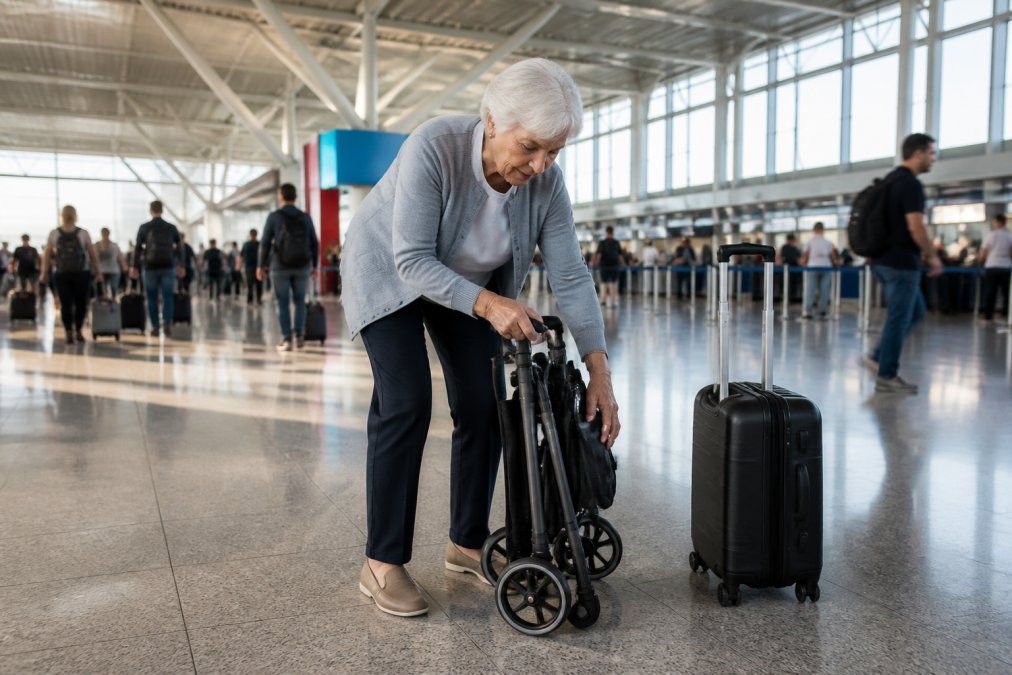
Folding Rollators and Walking Aids
A folding rollator is a wheeled walking frame with a seat and hand brakes that collapses flat for transport. Most models fold via a single central strap or a side-to-side hinge, and the lightest versions use aluminum frames.
Travel Scooters and Power Chairs
Travel scooters break into two or more pieces, with the heaviest section usually holding the motor and battery. Power chairs designed for transport work the same way.
| Aid Type | Folds or Breaks Down | Best For | Main Trade-Off |
|---|---|---|---|
| Folding rollator | Folds flat, one hand | Airport terminals, short walks | Limited seating comfort |
| Travel scooter | Breaks into 2-4 pieces | Longer distances, cruises | Heaviest piece needs lifting |
| Transport power chair | Frame separates | Full-day excursions | Airline battery approval |
| Walking cane with seat | Folds or telescopes | Occasional rest stops | Minimal support |
Best Luggage for Seniors With Limited Mobility
The best luggage for seniors with limited mobility is four-wheel spinner luggage with a hard shell, a wide telescoping handle, and a weight capacity matched to what the traveler can actually push. Bending to drag a two-wheel bag is the move that causes the most strain.
Spinner Wheels and Hard-Side Options
Spinner wheels let you push a suitcase upright beside you rather than pulling it behind. That keeps the wrist and shoulder in a neutral position and removes the need to twist. The trade-off is control: on carpet, ramps, and uneven sidewalks, a four-wheel spinner can drift, so look for dual-caster wheels (two wheels per corner) rather than single casters. Dual casters track straighter and roll over thresholds and jet-bridge gaps with less effort.
Weight Capacity and Storage Dimensions
Check two numbers before buying: the bag's empty weight and its internal storage dimensions. An empty weight under 8 pounds keeps a packed bag manageable for most travelers. Above that, the bag itself starts to compete with the gear you need to carry.
Pairing Luggage With a Mobility Aid
This is the piece most guides skip. When you travel with a rollator or a folding scooter, you are managing two objects at once, and the luggage has to cooperate.
- A bag with a rear sleeve or strap that slides over a rollator handle lets you push the aid and tow the bag in one motion instead of making two trips.
- A bag that stands on its own (four wheels, flat base) frees both hands for the aid when you stop to rest.
- A personal item that clips to the aid keeps medication, documents, and a phone within reach without digging through a larger bag.
Comfort Accessories That Reduce Physical Strain on Long-Haul Travel
Compression socks, lumbar cushions, and joint support sleeves can enhance long-haul comfort, potentially by reducing swelling and taking pressure off the lower back.
Senior Travel Safety Tips for Hotels, Airports, and Beyond
The most useful senior travel safety tips focus on three things: securing the hotel room, moving through airports without rushing, and keeping essential information accessible. Requesting wheelchair assistance at booking is the single easiest win.
Room Safety Tools and Digital Travel Apps
Portable door locks, motion-sensor night lights, and grab-bar suction handles make a hotel room safer without any installation. Pack a night light for the path between bed and bathroom.
Mobility Scooter and Wheelchair Rentals: When to Rent vs. Bring Your Own
Renting a mobility scooter or wheelchair makes sense for trips where you need the device only part of the time, or when your own equipment is too heavy to fly with. Bringing your own wins when you rely on it daily and know its fit.
When Renting Wins
- Short trips with a lot of walking. A week in a walkable city where you only need the scooter for two or three long days is a rental trip.
- Cruises and resort stays. Many cruise lines and resorts have on-site rental partners, so the device is waiting at the pier or the lobby.
- You cannot lift your own device. If your scooter breaks into pieces you cannot manage alone, renting a lighter model on arrival removes that problem entirely.
- You want to try before you buy. A rental is a low-commitment way to test whether a scooter or power chair suits your travel style.
When Bringing Your Own Wins
- You use it every day at home. Familiarity with controls, seat height, and turning radius is a safety feature, not a luxury.
- Your device is fitted to you. A rented scooter has a different seat height and tiller angle than what your body is used to.
- You need it at the airport. A rented device usually meets you at the destination, not at your departure gate.
Questions to Ask Before You Rent
Get answers in writing, not over the phone. The details that matter:
- Delivery and pickup. Does the company deliver to your hotel, the cruise terminal, or the airport? Is there a delivery window, and what happens if your flight is delayed?
- Battery range and charging. How far does it go on a full charge, and how long does a full charge take? Ask whether the charger works on the voltage at your destination.
- Breakdown coverage. If the device fails mid-trip, does the company swap it, repair it, or refund it? What is the response time?
- Damage and liability. What does the rental agreement say about damage, and is a damage waiver or deposit required? Read the terms before you sign.
- Accessibility of the device itself. Does it break down for transport in a taxi or rideshare, and does it fit through a standard hotel room door?
What to Do If a Rental Fails Mid-Trip
This is the scenario most rental guides ignore. If your rented scooter or wheelchair stops working:
- Call the rental company first, not the hotel. The rental agreement usually makes the company responsible for a swap or repair.
- Document the failure with a photo and a note of the time and location. This matters if you need to dispute a charge.
- Ask for a loaner while yours is being repaired or replaced. Many companies keep spare units in popular destinations.
- If the company cannot respond, a local mobility equipment shop can often rent or repair a device same-day. Hotel front desks usually know which shops are nearby.
Maintenance and Troubleshooting on the Road
A small repair kit prevents most mid-trip breakdowns. Pack hex keys in the sizes your aid uses, a spare brake cable if your model allows it, and a tire pump for pneumatic wheels.
Conclusion
Traveling with a mobility aid asks more planning than traveling without one, and the gear you choose decides how much of that planning turns into stress. Journey Must Haves offers a thoughtfully curated collection of travel essentials designed to enhance comfort, convenience and security for every adventurer. Our products are specifically selected to help overcome physical and logistical limitations and challenges, empowering individuals to seize every travel opportunity with confidence.
Frequently Asked Questions
What lightweight mobility aids are best for air travel?
Folding rollators and travel-specific walkers are the most practical choice for air travel because they collapse into a compact size and weigh less than 15 pounds. Look for models with a one-hand folding mechanism, a seat for resting, and a weight capacity that matches the user. Check with your airline before flying, since policies on bringing mobility aids into the cabin vary by carrier and aircraft. A lightweight aid that folds small enough for an overhead bin or gate-check tag keeps the traveler moving without depending on airport staff.
How can seniors maintain independence while traveling?
Independence during travel comes from preparation, not from bringing every possible item. Pack lightweight mobility aids that fold, choose luggage with spinner wheels and a hard shell, and add comfort accessories like compression socks and a supportive seat cushion. Book accessible hotel rooms in advance and download travel apps that map accessible routes. Practicing with new gear at home before the trip builds confidence. When travelers can manage their own bags, navigate terminals, and rest when needed, they stay in control of the journey rather than relying on others for every step.
What should seniors look for in travel luggage for ease of use?
Prioritize spinner wheels that roll in any direction, a hard-side shell that protects contents, and a handle that extends without bending the wrist. Check the weight capacity and storage dimensions against what you actually pack. Bending reduction matters: a bag that opens flat at waist height saves the back and hips. Look for distinct colors or tags so the bag is easy to spot on a carousel. For anyone with limited mobility, a lighter empty weight is worth more than extra compartments, because every pound counts when lifting the bag into a taxi or overhead bin.
Are there travel-friendly walking aids that are easy to pack?
Yes. Folding walking aids with a hinge mechanism collapse to roughly the size of a small duffel and fit in most car trunks or overhead bins. Some models include a carry strap or travel bag. Before buying, measure the folded dimensions against your luggage and check the weight capacity. If the traveler uses a rollator with a seat, confirm the folded size fits the vehicle and hotel room. Practicing the folding mechanism at home prevents fumbling at the gate. A walking aid that packs easily means the traveler keeps their routine without extra hassle.
Traveling with mobility gear is a logistics problem as much as a comfort one. Journey Must Haves selects products specifically to help travelers overcome physical and logistical challenges, so independence does not end at the departure gate. Explore Our Collections and find the gear that fits your next trip.