

Travel Comfort Products for Back Pain
Table of Contents
- Why Back Pain Gets Worse During Travel
- Ergonomic Seat Cushions for Airplanes
- Inflatable Lumbar Support for Travel
- Heat Therapy and Portable Heating Solutions
- How to Prevent Back Pain During Long Flights
- Compression Socks and Lower-Body Circulation
- Post-Travel Recovery and Budget-Friendly Options
- Frequently Asked Questions
Last Updated: September 22, 2026
Back pain during travel isn't just uncomfortable, it's a barrier to the experiences you want to have. Whether you're flying across the country for business or taking a long road trip with family, the strain of sitting in confined spaces, combined with poor posture support and limited movement, compounds existing pain and creates new problems. This guide covers travel comfort products for back pain that actually address the root causes of discomfort rather than masking symptoms temporarily.
We've selected travel comfort products for back pain that are portable and effective, not miracle cures, but real solutions that address the mechanics of travel-induced discomfort.
Why Back Pain Gets Worse During Travel
Travel amplifies back pain by combining compression, immobility, and poor seat design. At home, you shift position constantly; during travel, you're locked in place for hours.
Dehydration stiffens muscles and reduces shock absorption. Post-travel soreness peaks 24-48 hours after arrival as inflammation develops.
Ergonomic Seat Cushions for Airplanes
An ergonomic seat cushion works passively, no maintenance required during your flight.
The Ergonomic Memory Foam Seat Cushion ($64.99) uses slow-rebound memory foam that conforms to your body's contours while maintaining firm support. The breathable mesh cover prevents heat buildup during long flights, which matters because sweating increases stiffness. Size is 46×43×12 centimeters, which fits standard airplane seats and office chairs.

Memory foam redistributes pressure evenly across your seat, reducing compression on your lumbar spine and promoting proper pelvic tilt.
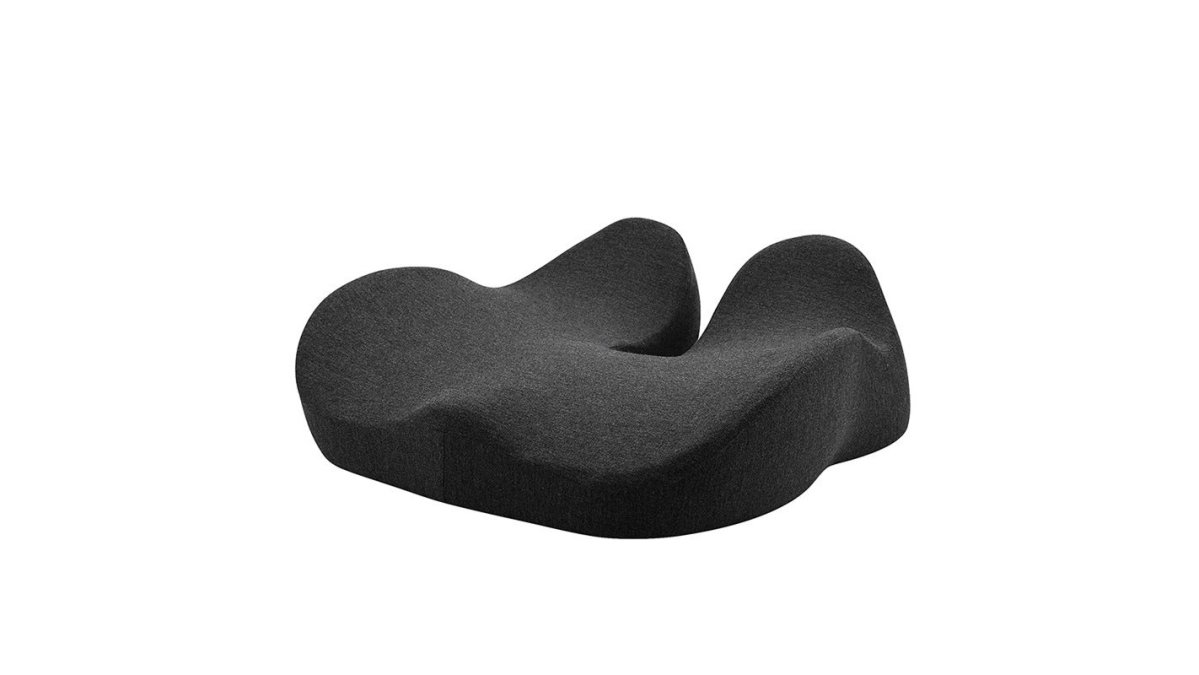
Generic foam loses support within hours; memory foam maintains structure throughout a 6-10 hour flight.
Inflatable Lumbar Support for Travel
Inflatable lumbar supports offer adjustable firmness in minimal luggage space, letting you customize support based on daily needs.
Inflatable supports prevent your spine from collapsing into a C-curve (which stretches ligaments and compresses discs) by maintaining natural lumbar lordosis.
They require active adjustment and may need readjustment mid-flight. Best for travelers with diagnosed conditions requiring precise support.
Heat Therapy and Portable Heating Solutions
Heat therapy increases blood flow and reduces muscle tension.
Product Options by Travel Style

The USB Heated Shoulder Support Wrap ($51.42) combines heat with vibration massage for upper back and neck tension. The vibration breaks up muscle tension through rapid micro-movements, making it more effective than heat alone.
For lower back pain, the Electric Heating Knee Massager ($80.99) can be repositioned to target your lumbar region with multi-level heat and vibration settings.
Reusable gel heat packs work 30-45 minutes per activation. Trade-off: they require hot water access, limiting plane use but ideal for hotels.
Timing and Effectiveness During Travel
Use heating devices during rest periods, not on planes. For long layovers (4+ hours), a 20-minute session in an airport lounge significantly reduces stiffness.
For flights over 8 hours, apply heat within 2-4 hours of arrival while muscles are still warm. This prevents the inflammation spike that peaks 24-48 hours later.
How to Prevent Back Pain During Long Flights
Prevention is always more effective than treatment. These strategies reduce the likelihood that back pain will develop or worsen during your flight.
Move every 30-45 minutes. This is the single most important habit. Get up, walk the aisle, do a few gentle twists. Movement restores circulation and prevents muscles from locking into a static position.
Adjust your seat position. Most airplane seats recline slightly. Use this feature. A 5-10 degree recline reduces pressure on your lumbar spine compared to sitting fully upright. Avoid the temptation to recline fully, that creates a C-curve.
Ultimate Neck Relief: Cervical Traction →
Keep your knees slightly lower than your hips. This maintains proper pelvic tilt. If your knees are higher than your hips, your pelvis tilts backward and your lower back rounds. Place a small pillow under your knees if needed.
Stay hydrated. Dehydration stiffens muscles and reduces your body's shock-absorption capacity. Drink water consistently throughout your flight, not just when you feel thirsty.
Avoid prolonged static stretching before travel. Instead, do gentle dynamic movements (arm circles, leg lifts, torso rotations) that maintain muscle activation while improving mobility.
| Prevention Strategy | Duration/Frequency | Why It Works |
|---|---|---|
| Movement | Every 30-45 minutes | Restores circulation, prevents muscle locking |
| Seat recline | Continuous | Reduces lumbar compression by 5-10 degrees |
| Knee positioning | Continuous | Maintains proper pelvic tilt and spinal alignment |
| Hydration | Every 30 minutes | Keeps muscles flexible and reduces stiffness |
| Dynamic stretching | Before travel | Maintains stability while improving mobility |
Compression Socks and Lower-Body Circulation
Compression socks address a real mechanism: poor lower-body circulation contributes to overall muscle tension and stiffness.
During travel, blood pools in your calves and feet, reducing oxygen delivery and increasing inflammation. Compression socks apply graduated pressure to maintain circulation (pubmed.ncbi.nlm.nih.gov).
We offer three compression sock options: Sports Compression Socks ($22.99), Calf Compression Socks ($27.99), and Plus Size Compression Socks ($26.99, sizes 2XL-7XL).
All use graduated compression (highest at ankle, decreasing toward knee), which drives circulation upward rather than squeezing uniformly.
Better circulation reduces inflammation throughout your body, meaning less stiffness and faster recovery. Compression socks won't fix existing pain, but they reduce conditions that worsen it.
Post-Travel Recovery and Budget-Friendly Options
Recovery starts upon arrival. The first 24-48 hours determine whether pain becomes temporary discomfort or extends into days of soreness.
The Post-Travel Inflammation Timeline
Inflammation peaks 24-48 hours post-travel, not immediately. Most travelers feel fine on day one, then experience worse pain on days two or three, this is predictable, not a sign of injury.
Hours 0-4 (Immediate Arrival): Apply heat for 15-20 minutes while muscles are still warm. Use the USB Heated Shoulder Support Wrap ($51.42) or a standard heating pad.
Hours 4-24 (First Evening and Night): Gentle movement is more important than rest. A 20-30 minute walk restores normal movement patterns and maintains circulation. Avoid intense stretching.
Hours 24-48 (Second Day): Inflammation peaks. Continue heat therapy (15-20 minutes, 2-3 times daily) and gentle movement.
Spinal Decompression and Trigger Point Release
The Ultimate Neck Relief: Cervical Traction Device ($44.13) releases muscle tension and trigger points in the neck and upper back. Use it for 5-10 minutes on your second day post-travel.

For lower back decompression, lie on your back with your knees bent and feet flat on the floor. Gently rock side to side for 2-3 minutes.
Budget-Friendly DIY Recovery Hacks
Rolled towel lumbar support ($0): Roll a hand towel into a 4-6 inch cylinder and place under your lower back while lying down. Use for 10-15 minutes on your first evening post-travel.
When to Seek Professional Help
Frequently Asked Questions
What is the best back support for airplane travel?
The best back support combines ergonomic seat cushions with inflatable lumbar support. Memory foam seat cushions like the Ergonomic Memory Foam Seat Cushion ($64.99) provide pressure relief for prolonged sitting, while portable cervical traction devices offer targeted support for neck and upper back pain. Choose based on your specific pain location: lumbar (lower back) needs seat cushion support, while cervical (neck) pain benefits from dedicated neck relief tools.
Are inflatable lumbar supports effective for long-haul flights?
Yes, inflatable lumbar supports are effective for long-haul flights because they maintain proper spinal alignment and reduce pressure on the lower back during extended sitting. They're lightweight, portable, and adjustable to your comfort level. Pair them with seat adjustments, increasing seat pitch when possible and using the recline function, to maximize spinal decompression and reduce muscle tension throughout your flight.
How do I prevent back pain during long flights?
Prevent back pain on long flights by combining multiple strategies: use an ergonomic seat cushion for pressure relief, wear compression socks to improve circulation and prevent deep vein thrombosis, adjust your seat posture every 30 minutes, and take brief walks in the cabin. Apply heat therapy before boarding if possible. The USB Heated Shoulder Support Wrap ($51.42) provides portable relief, while compression socks ($22.99-$27.99) maintain healthy blood flow in your legs and lower extremities.
What travel comfort products work best for chronic back pain?
For chronic back pain, combine ergonomic support with active relief: the Ergonomic Memory Foam Seat Cushion addresses sitting pressure, the Ultimate Neck Relief device ($44.13) targets cervical tension, and the Electric Heating Knee Massager ($80.99) provides therapeutic heat and vibration. Start with one product that matches your pain location, then add compression socks and heat therapy as needed. Many travelers find that layering these solutions, cushion plus heat plus movement, works better than any single product alone.