

Tips for Independent Travel with Disability: 2026 Guide
Table of Contents
- Pre-Trip Planning: Research, Documentation, and Travel Insurance
- How to Request Airport Wheelchair Assistance and Navigate Security
- TSA Cares Program for Travelers with Disabilities: What to Know
- Accessible Hotel Booking Tips for Verified Accommodations
- Traveling with Medical Equipment and Medications: Packing and Management
- Digital Accessibility Tools and Budgeting for Independent Travel with Disability
- Emergency Contingency Planning and Solo Travel Safety Protocols
- Frequently Asked Questions
Last Updated: September 19, 2026
Pre-Trip Planning: Research, Documentation, and Travel Insurance
Tips for independent travel with disability start long before you reach the airport. The travelers who move through terminals calmly are the ones who front-loaded the work: they researched their destination's infrastructure, gathered medical documentation, and confirmed what their travel insurance actually covers.
Start with a simple checklist:
- Confirm your destination's accessibility standards and transit authority services
- Request a letter from your physician listing diagnoses, medications, and equipment
- Call your insurer and ask specifically whether mobility equipment damage is covered
- Book flights with longer layovers than you think you need
That insurance call matters more than most people expect. Many standard policies treat wheelchairs and scooters as baggage, which caps payouts far below replacement cost. Ask whether your mobility aids are covered under the medical portion instead. For broader guidance on passenger protections, the DOT air travel consumer resources explain what airlines owe you when equipment is damaged.
How to Request Airport Wheelchair Assistance and Navigate Security
Request wheelchair assistance when you book your ticket, not when you arrive. Airlines and airports handle special assistance requests most reliably when they appear in your reservation at least 48 hours before departure. Under the Air Carrier Access Act, you can request wheelchair assistance at booking, at check-in, or at the gate, and an airline cannot require advance notice as a condition of providing it, but in practice, the earlier the request is in the record, the smoother the handoff between the check-in desk, the security checkpoint, and the gate.
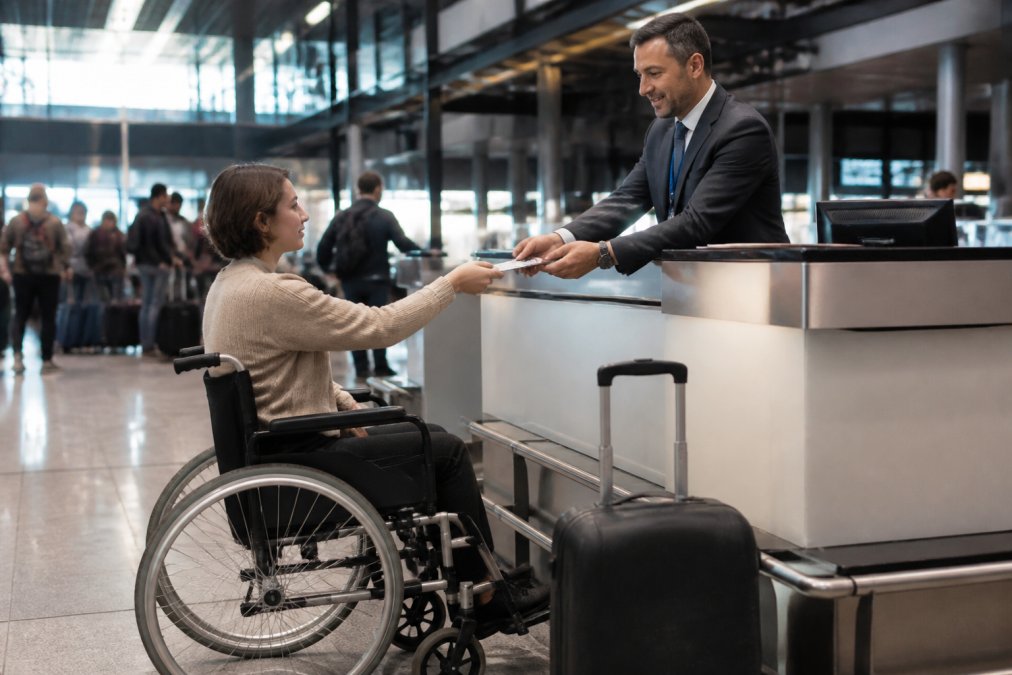
Here is the process that works:
- Add the assistance request in your booking, online or by phone
- Confirm it again at online check-in
- Arrive early and go straight to the special assistance desk
- Keep your boarding pass and ID accessible in a bag you can reach without standing
- Ask the agent for the name of the person who will push you to the gate, and note it
Security is usually the smoothest part of the journey, but only if you direct it. Tell the officer what you can and cannot do, and ask for a private screening if you prefer one. You never have to surrender a mobility aid for X-ray screening; canes, crutches, walkers, and wheelchairs are screened by hand or by alternate methods.
- The aisle chair gap. If you cannot walk to your seat, you transfer to an aisle chair at the jet bridge. Ask at the gate whether one is confirmed for your flight, because a missing aisle chair is one of the most common reasons travelers with mobility disabilities are denied boarding.
- The equipment handoff. Gate-checked wheelchairs and scooters are returned at the jet bridge, not the baggage carousel, on most domestic flights. Confirm the return point with the gate agent and get a written claim receipt for the equipment before you board.
TSA Cares Program for Travelers with Disabilities: What to Know
The TSA Cares program for travelers with disabilities provides a dedicated helpline you can call before your trip to arrange screening support. Travelers or companions can request a passenger support specialist who meets you at security and walks you through the process.
Accessible Hotel Booking Tips for Verified Accommodations
Accessible hotel booking tips begin with one rule: never trust a generic "accessible room" label. Call the property directly and ask for measurements, photos, and a description of the specific room you are reserving.
Ask these questions before you pay:
- What is the doorway width, and does it fit your chair or walker?
- Is the bathroom roll-in or transfer, and are grab bars installed?
- Is the accessible entrance the same as the main entrance?
- How far is the room from the elevator?
Traveling with Medical Equipment and Medications: Packing and Management
Traveling with medical equipment and medications requires two kits: one that stays with you and one that stays in your checked bag. Never pack medication or essential equipment in checked luggage.
Discover Unmatched Comfort with Ellese →
Your carry-on kit should hold:
- A seven-day supply of medication in original labeled containers
- Copies of prescriptions and your physician's letter
- Spare batteries or chargers for any powered device
- A printed list of your medications with generic names
Digital Accessibility Tools and Budgeting for Independent Travel with Disability
Digital accessibility tools and budgeting for independent travel with disability are the two angles most guides skip entirely. Both change how confidently you move, and both reward research done before you book.
- Blind and low-vision travelers. Screen readers such as VoiceOver on iOS and TalkBack on Android read transit apps and airline apps aloud, but only if those apps are built to support them. Beacons and indoor navigation apps can announce gates and restrooms inside large terminals. For reading menus, signs, and documents, optical character recognition apps convert a photo of text into speech.
- Deaf and hard-of-hearing travelers. Live transcription apps turn spoken announcements into on-screen text, which matters in terminals where gate changes are announced by voice only. Captioned telephone relay services let you make calls to hotels and taxi dispatchers without relying on hearing.
- Cognitive and sensory travelers. Visual scheduling apps and noise-meter apps help you preview a route and identify quiet spaces before you arrive.
- Mobility travelers. Step-free route planners and live elevator status feeds are the highest-value tools. Before you book anything, check whether your destination's transit authority publishes live elevator and escalator outage data, several major systems do, and a station that is step-free on paper can be out of service on the day you travel.
| Cost Category | What to Budget For | Money-Saving Move |
|---|---|---|
| Ground transport | Accessible taxi or shuttle | Book airport transfers in advance; ask whether paratransit-style service is open to visitors |
| Equipment rental | Mobility aids at destination | Ship your own gear instead; compare shipping cost against rental plus delivery fees |
| Accommodation | Accessible room premium | Book early, off-peak; ask whether a non-accessible room plus a rented shower chair is cheaper |
| Insurance | Mobility equipment coverage | Compare medical riders; confirm the payout cap on mobility aids |
| Attendant or companion | Extra fare or seat | Ask whether a personal care attendant flies free on your carrier |
Emergency Contingency Planning and Solo Travel Safety Protocols
Emergency contingency planning is what separates a manageable disruption from a ruined trip. Build a one-page contingency sheet before departure.
Include:
- Local emergency numbers and your embassy or consulate contact
- Your physician's name and number, plus a pharmacy near your hotel
- A backup plan if your mobility equipment fails
- Your travel companion or emergency contact's details
Frequently Asked Questions
How can I request airport wheelchair assistance?
Contact your airline at least 48 hours before your flight to request wheelchair assistance. Specify whether you need a wheelchair to the gate or to your seat. On travel day, arrive early and check in at the special assistance desk. You can also request assistance through the TSA Cares program for security screening. Confirm your request 24 hours before departure to ensure it is properly noted.
What is the TSA Cares program for travelers with disabilities?
TSA Cares is a helpline that provides information and assistance for travelers with disabilities, medical conditions, or other special circumstances. You can call 72 hours before your flight to ask questions about screening procedures and request a passenger support specialist to meet you at the airport. This service helps make security screening smoother and more predictable for independent travel with disability.
What essential documents should I carry when traveling with a disability?
Carry a written summary of your medical condition, a list of medications with generic names and dosages, and contact information for your doctors. Include copies of prescriptions, travel insurance details, and emergency contacts. If you use medical equipment, bring documentation of its necessity. Keep both digital and paper copies in your carry-on and with a travel companion if applicable.
How do I verify hotel accessibility before booking?
Call the hotel directly and ask specific questions about room features: door widths, grab bars, roll-in showers, and bed height. Request photos of the accessible room and bathroom. Confirm that accessible rooms are not booked out and that the hotel has a 24/7 contact for maintenance issues. Check recent reviews from guests with disabilities for verified accessibility insights.
Can I skip the TSA line with a disability?
You cannot skip security entirely, but TSA Cares and passenger support specialists can help you navigate the screening process more efficiently. You may be eligible for expedited screening if you have a medical condition or mobility aid. Communicate your needs to the TSA officer, and they will provide appropriate assistance, which may include a private screening area if needed.
What are the best seats on a plane for passengers with mobility challenges?
Aisle seats near the front of the cabin or bulkhead seats offer easier access and more space to maneuver. If you use a wheelchair, confirm that the seat has movable armrests for easier transfers. Avoid seats near emergency exits if you cannot assist in an evacuation. Check with your airline about seating accommodations when booking, and request a seat that meets your specific mobility needs.