

Portable Seat Cushions for Airplane Seats: 2026 Review
Table of Contents
- Why Portable Seat Cushions for Airplane Seats Matter
- Inflatable Seat Cushion for Airplane vs Memory Foam
- TSA Rules for Seat Cushions: What You Can Carry On
- How to Prevent Back Pain on Airplanes
- Our Top Pick: Ergonomic Memory Foam Seat Cushion Review
- Supporting Gear for Long-Haul Flight Comfort
- Frequently Asked Questions
Last Updated: September 13, 2026
Why Portable Seat Cushions for Airplane Seats Matter
Portable seat cushions for airplane seats solve a specific problem: economy class seats are built for space efficiency, not for the human spine. This guide from Journey Must Haves covers what actually works, what does not, and how to choose a cushion that survives both the flight and the security checkpoint.
The core issue is seat geometry. Most economy seats angle the pelvis backward, which flattens the lumbar curve and concentrates load on the tailbone. A cushion that restores even a small amount of pelvic tilt changes how weight distributes across the sit bones and lower back.
Economy Class and the Pressure Problem
Seat padding on commercial aircraft is thin by design. Airlines trade cushion thickness for weight and fuel savings, which means passengers absorb pressure directly through the ischium, the two bones at the base of the pelvis.
Sitting in that position for a long-haul flight restricts circulation and loads the lower back. Passengers with existing tailbone pain or sciatic nerve sensitivity feel it first, often within the first hour after takeoff.
A cushion does not fix the seat. It changes the interface between your body and the seat, which is the part you actually control.
Inflatable Seat Cushion for Airplane vs Memory Foam
The inflatable seat cushion for airplane travel and the memory foam cushion represent two different trade-offs. Inflatables win on packability. Memory foam wins on support and durability.

An inflatable cushion deflates to roughly the size of a paperback, which matters if you are traveling with carry-on luggage only. The catch is that air compresses unevenly under load, so the support feels firmer at the edges and softer under the sit bones.
Memory foam behaves the opposite way. It distributes pressure across a wider surface area through slow rebound, which is why cushion density matters more than thickness. A denser foam holds its shape across a long-haul flight; a cheap low-density foam collapses within an hour.
Weight, Packability, and Carry-On Fit
Weight is the deciding factor for many travelers. Inflatable options typically weigh less than a pound and fold flat. Memory foam cushions are bulkier and heavier, so they compete for space in a carry-on.
If you are already packing compression gear or mobility equipment, an inflatable cushion is the easier fit. If you check a bag, the memory foam cushion's bulk stops being a problem.
Pressure Relief, Cooling, and Durability
Support is only half the equation. Heat buildup is the other half, and it is the complaint most reviews skip.
Memory foam traps body heat unless the cover manages airflow. A breathable mesh cover makes a measurable difference over a multi-hour flight, and a cooling gel grid layer helps further. Inflatables run cooler because air does not insulate the way foam does, but they offer less orthopedic support.
On durability: inflatables are vulnerable to punctures and valve failure, while memory foam holds up over years of use.
| Feature | Inflatable Cushion | Memory Foam Cushion |
|---|---|---|
| Packed size | Folds flat, paperback-sized | Bulky, takes carry-on space |
| Weight | Under 1 lb | Heavier, 1-3 lbs typical |
| Pressure relief | Moderate, uneven under load | High, even weight distribution |
| Cooling | Runs cool, air does not insulate | Needs breathable or gel cover |
| Durability | Puncture and valve risk | Holds shape for years |
| Best for | Minimal packers, short trips | Long-haul flights, chronic pain |
TSA Rules for Seat Cushions: What You Can Carry On
TSA rules for seat cushions are simpler than most travelers expect, but the details matter because a cushion you cannot get through the checkpoint is useless. A seat cushion is not a liquid, gel, or aerosol, so it is not subject to the 3-1-1 liquids rule (tsa.gov). It travels as a personal item, which means it does not count against your carry-on bag allowance on most carriers.
The one caveat involves gel-filled cushions. If a cushion contains a gel layer, screeners may pull it for secondary inspection, and in rare cases a gel-filled item can be treated as a liquid. Foam and air cushions avoid that question entirely. If you fly with a gel model, expect the bin to come off the belt a second time.
Does a Seat Cushion Count Toward Your Carry-On Limit?
This is the question most guides skip, and the answer depends on how you carry it. Under standard airline carry-on policy, you are allowed one carry-on bag plus one personal item (faa.gov). A seat cushion carried separately, in your hand or strapped to your bag, is generally treated as the personal item. That means it does not eat into your overhead bin space.
The exception is bulkhead and exit rows, where some carriers restrict loose items during taxi, takeoff, and landing. If you are seated there, a flight attendant may ask you to stow the cushion under the seat in front of you or in the overhead bin until the seatbelt sign goes off.
Airline Policy Variance You Should Check Before You Fly
Airline policies on seat cushions are not uniform. Most major carriers allow them without comment, but a few practical patterns show up in frequent-flyer reports:
- Cushions with straps or clips that attach to the seat can raise questions on some carriers, because they modify the seat. Loose cushions are never an issue.
- Oversized orthopedic cushions that extend past the seat pan may be flagged in exit rows, where the seat must remain clear.
- Heated cushions with lithium batteries fall under separate battery rules and may need to be carried in the cabin, not checked.
Two practical notes from frequent flyers:
- Carry the cushion in your personal item, not your main carry-on, so it stays accessible if you are asked to gate-check a bag.
- If a cushion has a removable cover, pack it compressed and let it expand after security. Foam rebounds within a few minutes.
For the current rules, check the TSA guidance on what you can bring through security before you fly, since screening procedures change. If you are flying a carrier with strict cabin-item rules, confirm the cushion policy with the airline directly, because gate agents enforce inconsistently.
How to Prevent Back Pain on Airplanes
Preventing back pain on airplanes comes down to three things: seat position, movement, and load distribution. No single accessory does all the work, and the cushion is only as effective as the way you sit on it.
Start with the seat itself. Recline slightly if the row behind you allows it, since a small recline reduces the load on the lumbar spine compared with sitting fully upright for hours. Then place your cushion so the thicker edge sits under your thighs, not under your tailbone. This tilts the pelvis forward and restores part of the natural lumbar curve.
Movement matters as much as position. Stand and walk the aisle when the seatbelt sign is off, and do seated ankle pumps and knee lifts when it is not. Compression socks support circulation in the lower legs, which is where long-haul flights cause the most problems.

The Orthopedic Mechanism: Why Placement Beats Padding
A cushion does not work by being soft. It works by changing the angle of your pelvis. When you sit in a standard economy seat, the seat pan slopes backward and your pelvis rotates posteriorly, which flattens the lumbar curve and loads the discs and the tailbone. A wedge-shaped cushion with a thicker front edge reverses part of that rotation.
This is the same principle physical therapists use with wedge cushions in clinical settings for tailbone pain and sciatic nerve sensitivity. The goal is not cushioning the ischium, the two bones at the base of the pelvis. The goal is unloading the coccyx and reducing the posterior tilt that compresses the lower back. Most practitioners find that a modest wedge, roughly 2 to 4 inches of rise at the front edge, is enough to change the sitting angle without pushing the knees too high.
If you have an existing disc issue or sciatica, the cushion is a support tool, not a treatment. A physical therapist can tell you whether a wedge, a cutout cushion, or a donut-style design fits your specific pattern of pain.
How to Install the Cushion Discreetly in a Cramped Economy Seat
Setup is where most people get it wrong, and doing it awkwardly is worse than not doing it at all. A simple sequence keeps it quick:
- Board with the cushion in your personal item, not in your hand, so you are not juggling it in the aisle.
- Wait until the passenger next to you is seated and the aisle is clear.
- Slide the cushion onto the seat pan with the thick edge forward, under your thighs, and the thin edge back toward the seat.
- Sit down and shift your weight once to seat the foam. Slow-rebound foam takes a few seconds to conform.
- Tuck the empty stuff sack into your personal item, not the seatback pocket, so you do not leave it behind.
Reversed, the cushion pushes the pelvis into the same backward tilt the seat already creates, which makes back pain worse, not better.
Seat Etiquette and the Space You Actually Control
Etiquette is the unspoken part. A cushion adds height, which matters if you are in a bulkhead row or a seat with a fixed armrest. Check that the cushion does not block the person behind you from reclining, and keep it within your own seat footprint.
A few rules of thumb:
- Do not strap or clip the cushion to the seat. Loose cushions are less likely to draw a flight attendant's attention and do not modify the seat.
- If the cushion raises your knees into the seatback in front of you, it is too thick for that row. Switch to a thinner wedge or an inflatable you can partially deflate.
- In an exit row, keep the cushion off the floor during taxi, takeoff, and landing. Exit-row floors must stay clear.
Our Top Pick: Ergonomic Memory Foam Seat Cushion Review
The best portable seat cushion for most travelers is the Ergonomic Memory Foam Seat Cushion from Journey Must Haves. It pairs memory foam with a breathable mesh cover, which addresses the two failure points of cheap cushions: collapsing support and trapped heat.
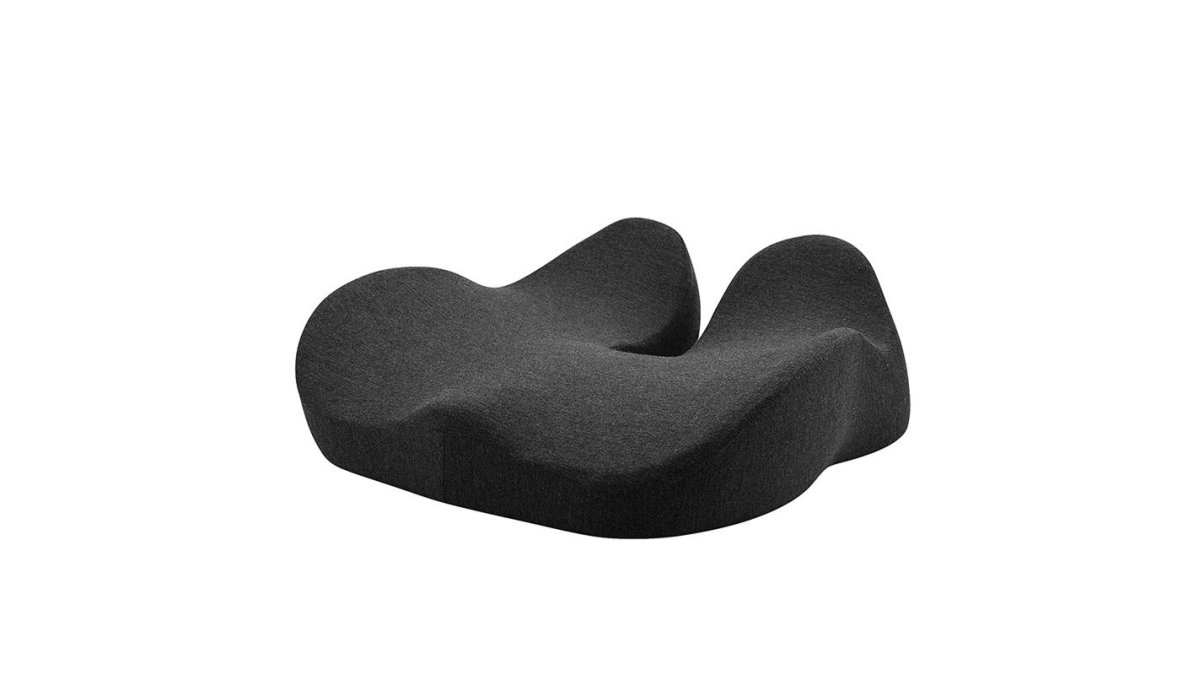
The slow-rebound foam distributes weight across the sit bones rather than concentrating it, which is the mechanism behind pressure relief. The mesh cover keeps air moving, so the foam does not turn into a heat trap on a long-haul flight.
Specs, Price, and Pros and Cons
Specifications:
- Material: Memory foam with breathable mesh cover
- Size: 46 x 43 x 12 cm
- Colors: Dark gray, light gray, green, pink, black, gray
- Price: $64.99, one-time purchase
Pros:
- Slow-rebound memory foam holds support across long flights
- Breathable mesh cover reduces heat buildup
- Ergonomic shape supports pelvic tilt when placed correctly
- Works in office chairs and at home, not just on planes
Cons:
- Bulkier than an inflatable, so it competes for carry-on space
- Not a gel-filled cooling design, so very hot sleepers may still run warm
Supporting Gear for Long-Haul Flight Comfort
A cushion handles pressure. It does not handle circulation, warmth, or the general discomfort of a cold cabin, and those are worth addressing separately.
Compression socks are the highest-value addition for long-haul flight comfort. Graduated compression supports blood flow in the lower legs during hours of sitting, which is where stiffness and swelling start. Journey Must Haves carries Sports Compression Socks at $22.99 in a breathable nylon build, plus a plus size range from 2XL to 7XL at $26.99.

Cabin temperature is the other variable. A USB-powered heated blanket shawl at $18.99 warms up in about 8 seconds and runs off a power bank, which beats the thin airline blanket on a red-eye.
If you want the full setup, explore the Journey Must Haves collections and build the kit around your specific needs rather than buying generic travel gear.
Frequently Asked Questions
Are portable seat cushions allowed on airplanes?
Yes. TSA does not restrict seat cushions in carry-on or checked baggage, and airlines permit passengers to bring their own cushions on board. The main practical limit is size: a cushion that fits within your carry-on allowance and sits flat on the seat is fine. Inflatable models deflate to the size of a paperback, while memory foam cushions like the Ergonomic Memory Foam Seat Cushion (46 x 43 x 12 cm) need dedicated bag space. Check your airline's carry-on dimensions before you pack.
Do seat cushions actually help with airplane back pain?
They can, depending on the source of your pain. A cushion with ergonomic support and pressure relief raises your hips and reduces compression on the tailbone and sciatic nerve, which is where economy class seats cause the most trouble. Memory foam distributes weight across a wider area than a flat seat. If your pain comes from a structural spine issue rather than seat pressure, a cushion alone may not be enough. Talk to your doctor about what your specific condition needs.
What is the best type of cushion for long flights?
It depends on your priorities. Inflatable cushions pack down to almost nothing and let you adjust firmness, which suits travelers who move between flights and want minimal luggage weight. Memory foam holds its shape, offers consistent pressure relief, and does not need re-inflating mid-flight. For a long-haul flight where comfort matters more than packability, a memory foam cushion with breathable fabric and a non-slip base is usually the better choice.
Will a gel seat cushion fit in a standard economy seat?
Most gel and memory foam cushions are designed to fit standard economy seats, but seat width varies by airline and aircraft. Measure your cushion against your seat's usable width before you fly. A cushion that overhangs the seat edge can shift during the flight. Look for a non-slip base and a compact profile. If you are unsure, inflatable cushions let you adjust the fill level so the cushion stays within the seat footprint.
How do you pack a seat cushion for air travel?
Inflatable cushions fold or roll into a carry-on pocket or attach to your bag with a strap. Memory foam cushions do not compress the same way, so plan for them to take up roughly the footprint of a laptop sleeve. Many travelers carry the cushion on board rather than packing it, since it counts as a personal item and is accessible during the flight. A carry strap or compression strap keeps it compact and easy to manage through security.
The right portable seat cushion for airplane seats comes down to one trade-off: packability or support. If you travel with a checked bag or fly long-haul regularly, support wins, and the Ergonomic Memory Foam Seat Cushion delivers it with slow-rebound foam and a breathable mesh cover. If carry-on space is your hard limit, an inflatable is the compromise. Get started with Journey Must Haves and build a travel kit that keeps you comfortable from the gate to the gate.