

Lightweight Mobility Aids for International Travel
Table of Contents
- Why Lightweight Mobility Aids Matter for International Travel
- Understanding Airline Policies for Mobility Devices
- Types of Travel-Friendly Mobility Aids
- How to Pack Mobility Aids for Flights
- Tips for Navigating Airports with Limited Mobility
- International Travel Logistics: Beyond the Airport
- Essential Travel Accessories to Complement Your Mobility Aid
- Conclusion
- Frequently Asked Questions
Last Updated: September 25, 2026
Why Lightweight Mobility Aids Matter for International Travel
Traveling with limited mobility doesn't mean staying home. The right lightweight mobility aids for international travel transform how you move through airports, navigate foreign cities, and reclaim independence abroad. But choosing between manual wheelchairs, compact rollators, power chairs, and mobility scooters, each with different portability trade-offs, requires understanding what actually works across borders.
The challenge is finding a mobility aid compact enough to gate-check, durable enough to survive baggage handling, and practical enough to use in tight European hotel rooms or crowded Asian markets.
This guide covers the types of travel-friendly mobility aids worth considering, how to navigate airline policies without surprises, and the logistics most travelers discover too late, like finding repair services in a country where you don't speak the language.
Understanding Airline Policies for Mobility Devices
Airline regulations for mobility devices vary significantly. The FAA classifies mobility aids as assistive devices, typically transported free and handled separately from checked baggage, but each airline interprets these rules differently.
Most carriers gate-check manual wheelchairs and rollators at no charge (loaded last, retrieved first). Power chairs and mobility scooters require advance notice, battery documentation, and may have device limits.
Before booking, contact your airline directly for written policy. Ask about battery types (lithium-ion vs. lead-acid), weight limits, and advance notice requirements.
Screenshot the policy with the date and bring a copy to the airport for protection against disputes.
Types of Travel-Friendly Mobility Aids
Manual Wheelchairs and Compact Rollators
Travel wheelchairs with collapsible frames are designed for portability. Advantages: no batteries, charging, or documentation. Trade-off: physical effort on long terminals or uneven streets.
Compact rollators offer a middle ground: lighter than wheelchairs, more independent than canes, with fold-down size and built-in seats for resting.
Both are often gate-checkable and typically do not require battery documentation.
Limitations emerge in practice: cobblestone streets, narrow staircases, and poor accessibility in less-developed areas can make manual options exhausting.
Power Chairs and Mobility Scooters
Power chairs and mobility scooters offer independence but require battery documentation and advance airline coordination (typically 48 hours notice).
Lithium-ion batteries face stricter regulations than lead-acid. Some international carriers prohibit them, meaning your power chair may travel separately or be rejected.
Travel-specific power chairs (40-60 pounds, foldable) solve portability but cost more. Mobility scooters rarely fold and are impractical for air travel unless rented at destination.
For extended trips in one location, renting abroad often makes more sense than traveling with a device.
How to Pack Mobility Aids for Flights
Practice collapsing your manual wheelchair or rollator at home and take a photo to show airline staff if needed.
For power chairs, document battery specs (Wh, voltage, amp-hours), print them, and complete any required airline paperwork before the airport.
Pack accessories (cushions, backup batteries, cables) in carry-on. Include compression garments to prevent deep vein thrombosis during long flights (Checking your browser).
Use the TSA guidelines for traveling with mobility devices as a reference, though TSA rules apply only to domestic flights. For international travel, your destination country's customs rules may differ. Some countries have specific regulations about importing medical devices; others have none. Research before you travel.
Mini Washing Machine for Travel →
Create a simple packing checklist: device documentation, battery specs, charging cables, backup batteries if applicable, adapters for international outlets (Journey Must Haves offers Ultimate Worldwide Travel Plug Adapters that work in over 150 countries), and contact information for your device manufacturer in case you need support abroad.

Tips for Navigating Airports with Limited Mobility
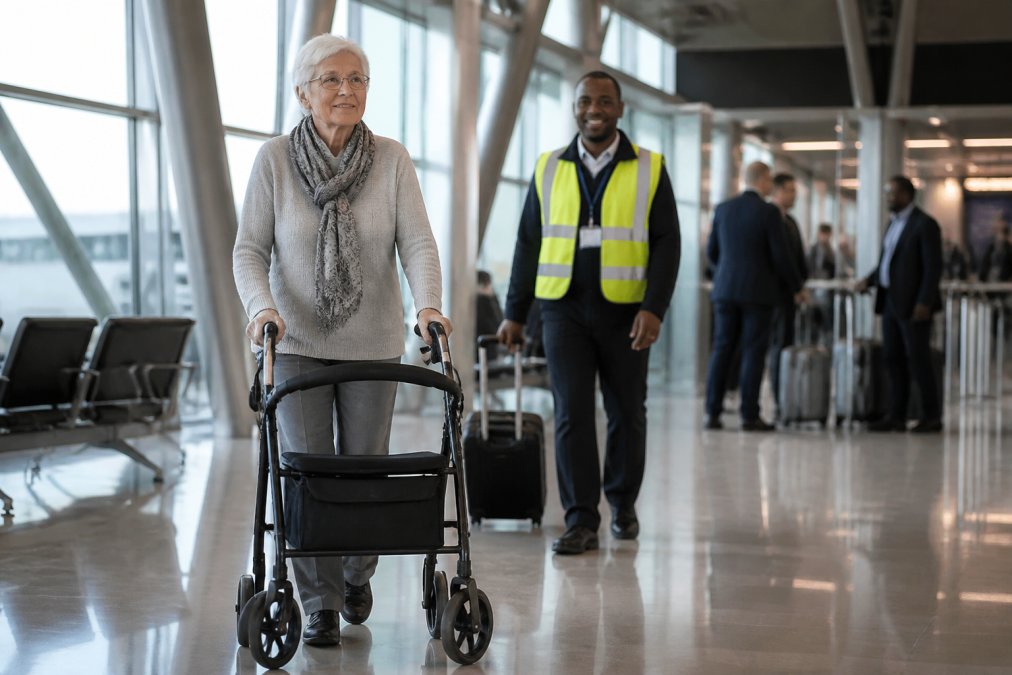
Airports are designed for speed, not accessibility. The distance from curb to gate can exceed half a mile, and most airports don't provide seating in corridors. Request wheelchair assistance or mobility aid support when you book your flight. This service is free and available at virtually every major airport.
When you arrive at the airport, go directly to the airline counter or assistance desk. Don't assume staff will notice your mobility aid. Tell them explicitly: "I'm traveling with a wheelchair and will need assistance boarding and deplaning." Provide your confirmation number and seat assignment. Staff will arrange for an escort to help you navigate the terminal, get to your gate, and board early.
Arrive earlier than usual, at least three hours for international flights. Security lines move slowly, and TSA may need to inspect your mobility device. If you use a power chair, inform the TSA officer before you reach the metal detector; they'll have you follow a specific screening process to avoid triggering alarms.
At the gate, confirm that your device will be gate-checked (retrieved at the jet bridge when you deplane) rather than checked through to baggage claim. Gate-checking is standard for wheelchairs and rollators but sometimes requires explicit confirmation. If your device is checked through, it may not arrive with you, especially on connecting flights.
During the flight, request an aisle seat if you have a manual wheelchair or if you need to move around the cabin. Aisle seats provide easier access to the restroom and allow you to stretch without climbing over seatmates. Most airlines accommodate these requests for passengers with mobility needs.
International Travel Logistics: Beyond the Airport
Customs Documentation and Cross-Border Requirements
Most countries don't require special permits to enter with a personal mobility device. The device is classified as medical equipment for personal use, not commercial goods. However, some countries have specific documentation requirements, and having the right paperwork prevents delays at customs.
Carry a doctor's letter stating that the mobility device is medically necessary for your condition. Include the device type, serial number, and battery specifications if applicable. This letter doesn't require official certification, a note from your physician on letterhead is sufficient. It serves as proof that the device is yours and medically necessary, not merchandise you're importing to sell.
For power chairs with lithium-ion batteries, keep battery documentation with your passport. Some countries' customs officials may question why you're importing batteries; the documentation explains their purpose.
If you're traveling to a country with strict medical device regulations (some European nations, for example), research their specific rules before departure. The U.S. State Department travel advisory database provides country-specific information, though it rarely covers mobility device regulations specifically. Contact your destination country's embassy or consulate directly if you're uncertain.
Rental vs. Purchase for Extended Trips
For trips longer than two weeks, renting a mobility device at your destination often makes more financial and logistical sense than traveling with one. You avoid airline complications, battery documentation, and the risk of damage during transport. You also gain access to devices optimized for local conditions, a scooter with wider tires for European cobblestones, for example, or a lightweight chair designed for narrow Asian staircases.
Rental agencies exist in most major cities worldwide. Search for "wheelchair rental" or "mobility scooter rental" plus your destination city.
Finding Repair and Maintenance Resources Abroad
The most overlooked aspect of international travel with mobility aids is what happens if your device breaks. A flat tire, loose wheel, or battery malfunction in a foreign country becomes a crisis if you don't know where to find help.
Essential Travel Accessories to Complement Your Mobility Aid
Beyond the mobility device itself, certain accessories significantly improve travel comfort and functionality. A quality travel backpack designed for accessibility, like Journey Must Haves' Laptop Backpack for Women, keeps essentials within reach without requiring you to hold bags or compromise your balance. The built-in USB charging port means you can charge devices while moving through the airport.

| Accessory | Best For | Travel Priority |
|---|---|---|
| Laptop backpack with USB port | Keeping essentials accessible and charging devices | High |
| Travel storage bags | Organizing medications and device accessories | Medium |
| Portable washing machine | Extended trips where laundry access is limited | Medium |
| Universal power adapter | Charging mobility device batteries and medical equipment | High |
| Compression garments | Preventing circulation issues during long flights | High |
Conclusion
Traveling internationally with limited mobility requires planning, but it's entirely achievable. The logistics, airline policies, battery documentation, customs procedures, become manageable once you understand them. The real opportunity lies in choosing the right mobility aid for your specific trip, packing strategically, and addressing the details most travelers overlook: repair resources abroad, rental options for extended stays, and accessories that make movement genuinely easier.
Frequently Asked Questions
What are the best lightweight mobility aids for air travel?
Manual wheelchairs under 50 pounds, compact rollators with folding frames, and travel-size mobility scooters are ideal for air travel. Look for aids with foldable designs, lightweight aluminum frames, and turning radiuses under 30 inches. Airline-approved options prioritize portability without sacrificing stability and weight capacity. Verify specific model approval with your airline before booking.
How do I ensure my mobility aid complies with airline policies for mobility devices?
Contact your airline at least 48 hours before travel to confirm their policies for mobility devices. Provide your aid's make, model, battery type (if applicable), and dimensions. Power chairs and scooters with lithium-ion batteries require special documentation and advance approval.
What should I pack when traveling internationally with mobility aids?
Pack medical device documentation, proof of purchase, battery certifications, spare parts, and a portable toolkit. Use compression storage bags to maximize suitcase space for clothing and essentials. Bring copies of your prescriptions and medical history. Include contact information for manufacturers and authorized repair centers in your destination. A 6-piece travel storage bag set helps organize medications, accessories, and documents separately.
How can I navigate airports safely with limited mobility?
Request accessible parking and curbside check-in. Use airport assistance services at least 2 hours before departure. Take advantage of accessible restrooms and family lounges. Ask TSA agents for assistance with security screening. Wear comfortable, accessible clothing. Use luggage with wheels and consider anti-theft backpacks with USB charging ports to keep devices powered. Pre-board when offered to avoid crowded aisles.