

Ergonomic Travel Gear for Hip Arthritis: 2026 Guide
Table of Contents
- Why Standard Travel Gear Fails Arthritic Hips
- Best Seat Cushions for Hip Pain on Planes and in Cars
- How to Manage Hip Pain While Flying: Seat Selection and Movement
- Best Walking Shoes for Hip Arthritis: Cushioning and Stability
- Compression Wear and Circulation Support for Long Travel Days
- Luggage and Mobility Aids That Reduce Hip Strain
- Post-Travel Recovery and Rental Car Ergonomics
- Frequently Asked Questions
Last Updated: September 27, 2026
Why Standard Travel Gear Fails Arthritic Hips
Ergonomic travel gear for hip arthritis is equipment designed to reduce joint stress during transit by improving weight distribution, cushioning pressure points, and supporting circulation, and the right ergonomic travel gear makes every stage of the journey easier on the joint. Standard luggage, seats, and footwear are built for average bodies, not for hips with limited range of motion. This guide from Journey Must Haves breaks down what actually helps.
Best Seat Cushions for Hip Pain on Planes and in Cars
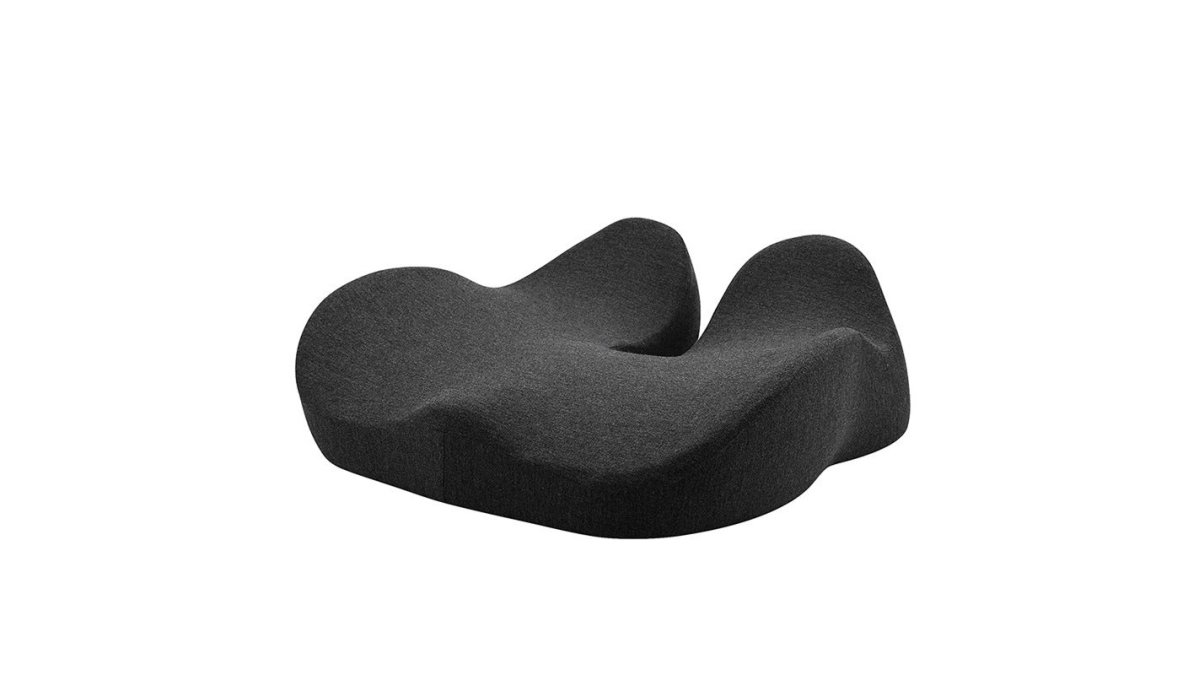
The best seat cushion for hip pain is a memory foam model thick enough to raise your hips above a hard seat edge while staying portable. Look for slow-rebound foam, a breathable cover, and a shape that supports the thighs, not just the tailbone.
What to Look For in a Travel Cushion
- Slow-rebound foam: supports the joint without collapsing after an hour
- Breathable cover: reduces heat buildup on long flights
- Grippy base: stops the cushion sliding forward mid-journey
- Wedge or contoured shape: keeps hips level and reduces pressure on the joint
- Compact size: fits a carry-on without eating your packing space
How to Manage Hip Pain While Flying: Seat Selection and Movement
Managing hip pain while flying comes down to two things: choosing a seat that lets you change position, and standing up before stiffness sets in. Aisle seats on the left side of the aircraft usually give you the most room to extend a leg and rise without climbing over anyone.

Hip-Friendly Seat Selection Strategies
Most seat maps don't tell you this, but the row you pick changes how much your hip flexes for the whole flight.
- Choose an aisle seat on the left side to lead with your stronger leg when standing
- Avoid exit rows if you need to recline; they often don't
- Pick a seat near the lavatory if mobility is limited, but not directly beside it
- On a road trip, slide the car seat back and recline slightly to open the hip angle
Best Walking Shoes for Hip Arthritis: Cushioning and Stability
The best walking shoes for hip arthritis combine thick heel cushioning with a stable, supportive base. Shock absorption at the heel reduces the impact that travels up to the hip, while a firm midsole keeps your stride from rolling inward.
Look for these features:
- Heel cushioning: absorbs impact before it reaches the joint
- Arch support: keeps your gait aligned and reduces load on the hip
- Wide toe box: lets toes spread, which improves stability
- Lightweight build: less weight to lift means less strain per step
- Secure heel fit: prevents slipping that throws off hip alignment
Compression Wear and Circulation Support for Long Travel Days
Compression wear supports circulation during long travel days, when sitting still lets blood pool in the legs and adds to travel fatigue. Graduated compression applies firmest pressure at the ankle and eases upward, helping blood move back toward the heart (Graduated compression stockings).
Luggage and Mobility Aids That Reduce Hip Strain
Luggage that reduces hip strain rolls on four swivel wheels and pushes rather than pulls. A spinner case keeps your wrist and hip in a neutral line, while a two-wheel bag forces you to drag weight behind you and twist your pelvis with every turn. That repeated rotation is the motion arthritic hips tolerate worst, which is why the wheel count matters more than the bag's weight rating.
Picking the Right Bag for Your Hip
- Four-wheel spinner: pushes upright, keeps your torso square, and lets you switch hands without repositioning your hip
- Handle height: set it so your forearm stays roughly parallel to the floor; a handle that's too low makes you lean and load the joint
- Telescoping vs. fixed handle: a two-stage telescoping handle lets you match your height instead of hunching
- Soft-sided vs. hard-shell: soft-sided bags absorb bumps against your leg; hard-shell bags roll straighter but transmit more jolt on uneven carpet
- Weight distribution: pack heavier items in the middle of the case, near the handle, so the bag stays balanced and easy to steer
Keep a personal item light and crossbody rather than on one shoulder. A single-shoulder bag pulls your pelvis out of alignment with every step, and that misalignment compounds over a full travel day.
Mobility Aids for Airports and Beyond
Mobility aids should match the terrain. A rollator with large wheels handles airport carpet and uneven sidewalks better than a standard walker, and the built-in seat gives you a place to rest between gates. A cane with a wide, stable base is lighter for short trips but offers less support over long concourses.
Getting Through Security Without Flaring Your Hip
This is the step most travel guides skip, and it's where hip pain often spikes. Security checkpoints involve standing in a slow-moving line, bending to remove shoes, and lifting bags onto a belt, three movements that stress an arthritic hip in sequence.
Electric Heating Knee Massager with →
A few practical habits help:
- Request a pat-down or hand-check if bending to remove shoes or lifting a bag onto the belt is painful. Screening officers can accommodate this; you don't have to explain your diagnosis in detail.
- Ask about a private screening area if you use a mobility aid and would rather not be screened in the open queue.
- Keep medication and mobility-aid essentials in an accessible pocket so you're not digging through a packed bag while standing on a hard floor.
- Wear slip-on shoes with a secure heel so you can remove and replace them without bending fully.
- Arrive with buffer time. Rushing through a checkpoint is harder on the hip than the checkpoint itself.
Post-Travel Recovery and Rental Car Ergonomics
Most travel guides stop when you reach your destination. For arthritic hips, the day after arrival is often worse than the travel day itself, stiffness peaks after a long period of immobility, and the first morning back on your feet is when the joint feels most locked. A short, deliberate recovery protocol changes how the next 48 hours go.
A Day-After Recovery Protocol
Recovery starts the day you arrive, not the day after. After a long trip, give your hip 20 to 30 minutes of gentle movement before you sit down for the evening:
- Walk first, stretch second. A slow 10-minute walk gets synovial fluid moving through the joint before you ask it to lengthen.
- Hip circles and gentle flexion. Lie on your back and draw slow circles with the knee, then bring the knee toward your chest within a comfortable range. Stop short of pain.
- Heat before activity, ice after. Heat loosens a stiff joint in the morning; ice calms inflammation after a long walking day. A Electric Heating Knee Massager with Vibration Therapy at $80.99 delivers multi-level heat and vibration, though it is designed for the knee rather than the hip, a standard heating pad or warm shower works for the hip itself.
- Elevate and compress. If your legs swelled during travel, compression socks and a raised footrest help move fluid before bed.
- Protect the first morning. Keep your shoes and a stable chair within reach of the bed so you're not bending or reaching before the joint has warmed up.
Rental Car Ergonomics: The Gap Most Guides Skip
Rental car ergonomics are the piece almost every guide leaves out, and they matter because rental fleets skew toward low-profile sedans that sit close to the ground. Getting in and out of a low car is one of the hardest movements for an arthritic hip.

Choosing the vehicle:
- Request a crossover or SUV rather than a sedan when you book. The higher seat height means less hip flexion on entry and exit.
- Avoid two-door models. Longer doors on two-doors are heavier and harder to swing open from a seated position.
- Ask about seat height at the counter if you can't confirm the model in advance. Staff can often swap you into a higher vehicle.
Adjusting the seat before you drive off the lot:
- Slide the seat back so your hip angle stays open, roughly a 100- to 110-degree angle between torso and thigh is a common target.
- Recline the backrest slightly rather than sitting bolt upright.
- Set the lumbar support to fill the curve of your lower back.
- Move the steering wheel closer and lower so you don't reach or hunch.
- On longer drives, stop every 90 minutes to walk and stretch.
| Travel Problem | Gear Fix | Why It Helps |
|---|---|---|
| Hard, flat seats | Memory foam seat cushion | Cushions pressure points |
| Poor circulation in flight | Compression socks | Supports blood flow |
| Impact through the hip | Cushioned walking shoes | Absorbs shock at the heel |
| Heavy bag twisting your pelvis | Four-wheel spinner case | Pushes instead of pulls |
| Stiffness after sitting | Movement breaks every 90 min | Restores range of motion |
| Low rental car seats | Crossover or SUV request | Reduces hip flexion on entry |
| Day-after stiffness | Arrival-day recovery routine | Prevents the day-two crash |
Frequently Asked Questions
What features should I look for in travel cushions for hip pain?
Look for memory foam that slowly rebounds to distribute weight evenly, a breathable mesh cover to prevent heat buildup, and a thickness that raises your hips without throwing off your posture. The Ergonomic Memory Foam Seat Cushion uses slow-rebound memory foam and a breathable mesh cover, making it suitable for prolonged sitting in cars, planes, or office chairs. A cushion that is too soft will bottom out; one that is too firm can create pressure points.
Can compression gear help with hip arthritis during travel?
Compression socks support circulation in the lower legs, which can reduce swelling and travel fatigue during long periods of sitting. While they do not directly treat hip arthritis, better circulation and less fluid buildup in the legs can make standing up and walking after a flight feel less stiff. Options like the Calf Compression Socks for Sports and Cycling provide targeted pressure and moisture-wicking fabric for long travel days.
What type of luggage is easiest to maneuver with hip arthritis?
Four-wheel spinner luggage with swivel wheels lets you push the bag upright beside you rather than dragging it behind, which reduces torque on the hip. Look for ergonomic handles that are easy to grip and a lightweight frame. Pairing a spinner with a crossbody bag keeps your hands free for handrails and doors. If you use a mobility aid, practice steering the luggage with one hand before your trip.
How can I minimize hip stiffness during long flights?
Book an aisle seat so you can stand and stretch without climbing over anyone. Set a timer to get up every 60 to 90 minutes, even if just to walk to the back of the cabin. While seated, do ankle pumps, knee lifts, and gentle hip rotations. A seat cushion that supports your lumbar curve and keeps your hips level can reduce the buildup of joint stiffness between movement breaks.
Hip arthritis doesn't have to shrink your travel plans. The challenge is finding gear built for joints that need real support, not generic comfort items. Journey Must Haves curates travel essentials for exactly this, from the memory foam seat cushion that keeps hips level on long flights to graduated compression socks that support circulation and a spinner-friendly setup that takes the twist out of every turn. Explore Our Collections and pack for the trip you've been putting off.