

7 Comfortable Travel Accessories for Seniors in 2026
Table of Contents
- Why Standard Travel Gear Falls Short for Seniors
- Quick Comparison: Top Comfortable Travel Accessories for Seniors
- Supportive Footwear: The Foundation of Senior Travel
- Compression Socks for Long Flights: Circulation Support
- Lightweight Luggage for Seniors: Packing Smarter, Not Heavier
- Comfort Beyond the Seat: Cushions and Warmth
- Safety and Independence: Mobility Aids and Tracking
- TSA Travel Tips for Seniors: Smooth Security Screening
- Frequently Asked Questions
Last Updated: September 4, 2026
Why Standard Travel Gear Falls Short for Seniors
Standard travel gear is designed for the average 30-year-old, not for the 68-year-old with knee arthritis or the 75-year-old managing swollen feet. Comfortable travel accessories for seniors must be evaluated through a lens that prioritizes mobility support, circulation, and ease of use over aesthetics.

At Journey Must Haves, we curate gear specifically to overcome these physical limitations. Below, we'll show you how to build a travel kit that addresses your specific pain points, from long-haul flights to navigating airport terminals.
Quick Comparison: Top Comfortable Travel Accessories for Seniors
Choosing the right gear comes down to matching each product to your specific physical needs. The table below summarizes the top picks for senior travelers.
| Accessory | Best For | Key Feature | Price | | --- | --- --- --- | | Ellese & Co. Broadfit Footwear | Swollen feet, zero-drop comfort | Memory foam insole, adaptable lace-up | $44.85 | | Arch Support Walking Sneakers | Plantar fasciitis, wide feet | 3cm arch support, breathable mesh | $62.15 | | Ergonomic Seat Cushion | Hip/back pain on long sits | Memory foam, breathable mesh cover | $64.99 | | Compression-focused Insoles | Flat feet, high arch | 35mm arch height, shock absorption | $14.05 | | GPS Tracker | Peace of mind for families | Real-time tracking, 7g weight | $24.99 |

This is not a one-size-fits-all list. The right travel accessories for seniors address your primary limitation first, then layer on secondary comfort.
Supportive Footwear: The Foundation of Senior Travel
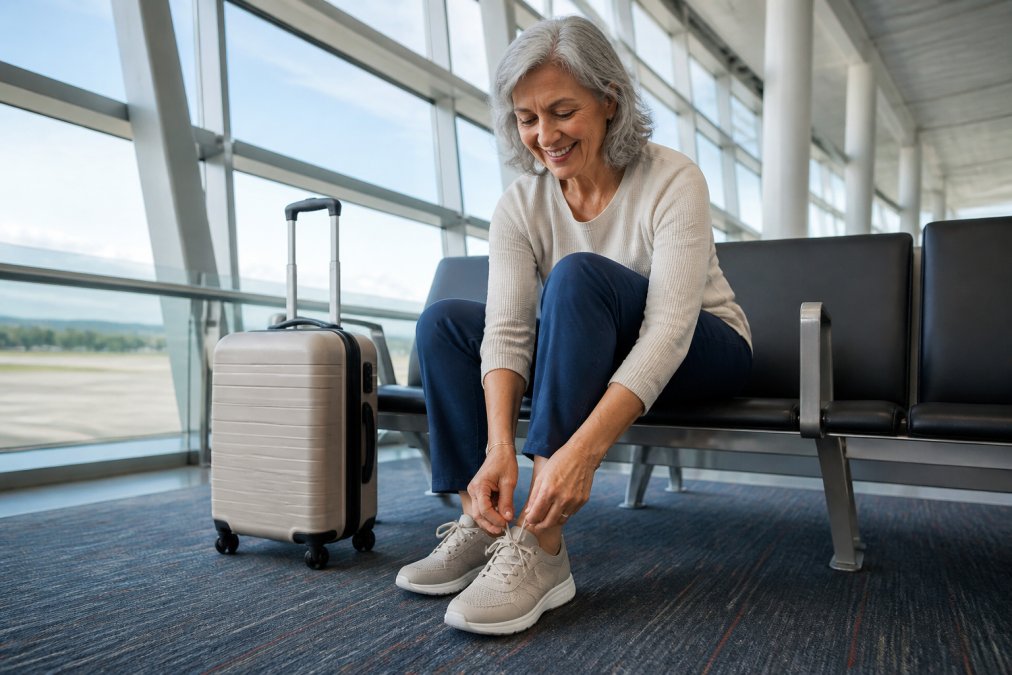
The most critical piece of comfortable travel accessories for seniors is footwear, because every step through an airport, museum, or city street depends on it.
Our top pick is the Ellese & Co. Broadfit Diabetic Footwear for Swollen Feet at $44.85. These shoes feature a zero-drop build that promotes natural foot posture, plus a memory foam insole that absorbs impact and relieves pressure during extensive walking. The adaptable lace-up design accommodates swelling that often worsens mid-flight or after a long day of sightseeing.
For women needing extra arch support, the Arch Support Wide Width Walking Sneakers at $62.15 offer a wide toe box, 3cm arch support, and a deep heel cup for plantar fasciitis and heel pain. The breathable mesh upper keeps feet cool, while the non-slip rubber outsole delivers reliable traction.
Compression Socks for Long Flights: Circulation Support
Long-haul flights are a known risk for deep vein thrombosis, especially for travelers over 60 (the CDC). Compression socks for long flights are non-negotiable, as they apply graduated pressure that keeps blood moving during hours of sitting.
The key is choosing the right compression level: mild (15-20 mmHg) for general fatigue, moderate (20-30 mmHg) for existing vein issues. Many travelers combine compression socks with the Orthopedic Sport Insoles at $14.05, which feature a 35mm arch height and a U-deep heel cup made of EVA memory foam with shock-absorbent PORON.
Wear compression socks for the entire flight, removing them during your post-flight shower. For significant foot swelling, the Plantar Fasciitis Therapy Wrap at $3.85 provides targeted heel and arch relief during recovery.

Lightweight Luggage for Seniors: Packing Smarter, Not Heavier
Lightweight luggage for seniors is about reducing the physical load your body must manage. A standard 50-pound suitcase forces your shoulders, back, and knees to compensate, quickly leading to fatigue.
The strategy starts before you buy luggage: pack only what you can lift. A good rule is that your packed bag should weigh no more than 10% of your body weight. Choose a carry-on with spinner wheels that glide alongside you rather than a duffel you must sling over your shoulder.
Luggage weight is a multiplier: every pound adds strain to your joints with each step. For seniors with arthritis or back issues, this strain accumulates rapidly. Consider shipping heavier items ahead or using a luggage delivery service.
Comfort Beyond the Seat: Cushions and Warmth
Airplane seats are engineered for density, not for the human body. The standard seat pan is flat, firm, and angled to maximize cabin capacity, not to support the sitting bones of a 65-year-old with reduced muscle mass. A seat cushion is a pressure-redistribution tool, not a luxury.
The Mechanics of Pressure Relief
When you sit, body weight concentrates on the ischial tuberosities. With age, muscle atrophy reduces natural padding, increasing pressure that restricts blood flow and causes pain. A good cushion increases the surface area of contact, spreading the load away from the bones.
There are two main types of cushion materials, and they work differently:
- Memory Foam (Viscoelastic): This material responds to body heat and molds to your exact shape. It provides deep immersion, which is excellent for distributing pressure evenly. The trade-off is that it can feel 'dead', it does not spring back, so it offers less support for getting in and out of the seat. It also retains heat, which can be uncomfortable on long flights.
- Gel: Gel cushions displace rather than mold. They provide a firmer, more stable surface that does not bottom out. They are better for heat dissipation, but they are heavier and can feel hard to some users.
A hybrid approach works best: a memory foam base for pressure relief with a gel top layer for stability and temperature control. The Ergonomic Memory Foam Seat Cushion at $64.99 uses slow-rebound foam, but the key is the breathable mesh cover that prevents heat buildup.
The Cold Factor: Why Warmth Is a Mobility Issue
Cold cabin air directly affects joint function. Synovial fluid thickens in cold temperatures, increasing stiffness. For a traveler with arthritis, a 15-minute walk through a cold terminal can be the difference between a smooth transfer and a painful limp.
The Heated Electric Blanket Shawl at $18.99 addresses this directly. Its carbon fiber elements warm up in 8 seconds, targeting the shoulders and upper back with 8 heating zones. It runs on a USB power bank, so you are not tethered to a wall outlet.
The Trade-Off You Must Consider
A heated shawl adds weight and requires managing a power bank. If traveling to a warm climate, it is dead weight; if your destination is cold or you are prone to cold-induced stiffness, it is a functional mobility aid. Base the decision on your destination's climate and personal sensitivity to cold.
Safety and Independence: Mobility Aids and Tracking
Maintaining independence requires proactive safety measures. The GPS Tracker for Pets Children Elderly at $24.99 offers real-time tracking with worldwide coverage, weighs just 7 grams, stores 7 days of movement history, and works with Android and Apple devices.
For winter travel, the Ice Claws Shoe Grips at $26.99 provide essential traction on snow and ice. Made with TPR/TPE and hardened manganese steel spikes, they maintain flexibility at -60 degrees and fit over existing walking shoes.
For bathroom safety in unfamiliar hotel rooms, the Suction Cup Non-Slip Bathroom Handrail at $31.99 installs without drilling or tools. Its textured grip provides stability in wet environments and supports up to 70kg, giving you a secure anchor point when showering or using the toilet.
TSA Travel Tips for Seniors: Smooth Security Screening
Most guides stop at 'wear slip-on shoes.' But the real bottleneck is the physical and cognitive load of navigating an unfamiliar, high-stress environment. The most effective strategy is to pre-plan the entire airport journey as a sequence of manageable steps.
Step 1: Request Assistance Before You Arrive
Airlines are required to provide wheelchair or cart assistance, but the booking process is often buried in fine print (transportation.gov). Call the airline's disability desk directly when booking, request 'curbside to gate' assistance, and specify if you need baggage help. This free service requires a reservation; waiting until arrival can cause 30-60 minute delays.
Step 2: Pre-Plan the Medical and Mobility Script
TSA officers follow a script. Before reaching the front of the line, have a single sentence ready: "I have a medical condition that limits my mobility, and I have [specific device/medication]." This triggers a different protocol.
For medical devices and medications, the rules are specific:
- Liquid medications in quantities over 3.4 ounces are permitted, but you must declare them at the checkpoint. They will be screened separately.
- Ice packs or gel packs for pain or swelling are allowed if they are medically necessary. Keep them in a separate bag and tell the officer.
- Mobility aids (canes, walkers, braces) must be screened via X-ray, but you can request a visual inspection if you cannot remove them quickly.
Step 3: The 'Pre-Check' Decision Is a Physical One
TSA PreCheck is a physical necessity for seniors, as the standard lane requires removing shoes, belts, and jackets, painful motions for those with arthritis. PreCheck costs $78 for five years. For travelers who fly more than once a year, the cost is justified by reduced physical strain alone.
Step 4: The Post-Security Reset
The walk to the gate is often the longest in the terminal. Plan a 'reset' at the gate: find a seat, remove your compression socks for 10 minutes, and rehydrate. This deliberate recovery step prevents the fatigue that leads to falls later in the day.
Step 5: The 'What If' Plan
Before leaving home, write down the airline's disability line and the TSA Cares helpline (1-855-787-2227). TSA Cares provides live assistance for travelers with disabilities; calling 72 hours before your flight can pre-empt surprises.
This is about preserving your physical and cognitive energy for the trip itself. The security checkpoint is a hurdle, not the destination. Planning for it with the same rigor as your itinerary is the difference between a trip that drains you and one that energizes you.
Frequently Asked Questions
What are the must-have items for a senior trip?
Focus on items that protect comfort and safety. Comfortable, supportive walking shoes with arch support are the top priority. For flights, bring compression socks to support circulation, a travel pillow for neck support, and a seat cushion for back and hip pressure relief. A lightweight suitcase with wheels reduces strain, and a portable power bank keeps devices charged. Organize medications in a clear pill organizer, and carry a small bag with hydration electrolytes. These essentials directly address the physical challenges of travel.
How can seniors make long-haul flights more comfortable?
Comfort on long flights starts before boarding. Wear loose, breathable clothing and supportive shoes. Put on compression socks before the flight to support circulation and reduce swelling. Choose an aisle seat to make standing and walking easier. Use an ergonomic neck pillow and a seat cushion to relieve pressure on your back and hips. Stay hydrated by drinking water and using electrolyte packets, and move your legs every hour. A USB-powered heated shawl can also help manage cabin temperature.
What are the TSA rules for seniors over 75?
Travelers 75 and older can keep light jackets and shoes on during screening at most airports. You can request a private screening if you feel uncomfortable with the body scanner, and you are allowed to ask for assistance from a TSA officer. Medications in pill form should be in your carry-on, and while they do not need to be in prescription bottles, labeling them can speed up the process. Consider TSA PreCheck to avoid removing shoes, belts, and laptops.
Are wide-width shoes necessary for senior travel comfort?
For many seniors, yes. Feet naturally flatten and widen with age, and conditions like bunions, arthritis, or swelling make standard-width shoes painful. Wide-toe-box shoes give your toes room to spread, which improves balance and reduces pressure. The Ellese & Co. Broadfit shoes ($44.85) feature a zero-drop build and memory foam insole, while the Women's Arch Support sneakers ($62.15) offer a wide toe box with arch support. Both are designed for extended walking comfort.
How do I choose the right travel accessories for specific mobility issues?
Start by identifying your most limiting physical challenge. For hip or back pain when seated, an ergonomic memory foam seat cushion provides pressure relief. For knee stiffness or joint pain, an electric heating knee massager can soothe discomfort after long periods of sitting. If balance is a concern, look for non-slip shoe grips for winter conditions or a suction cup handrail for hotel bathrooms. For peace of mind when traveling alone, a lightweight GPS tracker can offer real-time location monitoring.