

Buy Portable Mobility Aid Travel Cases: 2026 Guide
Table of Contents
- Hard Shell vs. Soft Shell Mobility Aid Travel Cases
- TSA Mobility Aid Travel Guidelines: What You Need to Know
- How to Pack a Wheelchair for Flying: Step-by-Step Protection
- Airline Approved Mobility Scooter Cases: What to Look For
- Joystick Protection and Interior Padding That Prevents Damage
- DIY Packing Hacks and Insurance for Damaged Equipment
- Portability Features: Wheels, Handles, and Straps That Matter
- Frequently Asked Questions
Last Updated: September 24, 2026
Hard Shell vs. Soft Shell Mobility Aid Travel Cases
Choosing between hard shell and soft shell cases is the first real decision when you buy portable mobility aid travel cases, and it comes down to one question: what is most likely to damage your equipment in transit? Hard shells win on impact resistance. Soft shells win on flexibility and storage.
Hard shell cases are built from molded plastic or composite materials that hold their shape under pressure. They protect against crushing, stacking, and the baggage-handling reality of heavy cargo shifting in a hold.
When Impact Resistance Matters Most
Impact resistance matters most for powered equipment and anything with a joystick, control module, or exposed motor housing. Those parts are expensive to replace and rarely covered without a fight.
When Flexibility and Storage Win
Soft cases win when your equipment folds small and you need the case to disappear between trips. They also handle irregular shapes better. A folding mechanism that doesn't collapse perfectly flat will fight a rigid shell every time.
TSA Mobility Aid Travel Guidelines: What You Need to Know
Mobility aids and assistive devices are not treated as standard checked baggage, and that distinction protects you. According to TSA guidance on traveling with disabilities and medical conditions, wheelchairs and mobility aids can be checked at the gate and are exempt from many standard baggage restrictions. What TSA does not do is protect your equipment from damage. Screening may involve manual inspection, and your case will be opened.
Gate-Check vs. Cargo: The Decision Most Travelers Get Wrong
Gate-checking does not mean your mobility aid rides in the cabin. It means you hand it over at the jet bridge and it is loaded into the cargo hold, then returned to you at the jet bridge on arrival (or, on some aircraft and routes, at baggage claim instead). The practical difference between gate-check and standard cargo check-in is where you surrender the item and where you get it back, not how gently it is handled.
- Will the item be returned at the jet bridge or at baggage claim?
- Is it loaded as a gate-checked item or as regular cargo?
- What is the damage-claim process, and who do I contact if something breaks?
Documentation Workflow That Protects Your Claim
Airlines are generally responsible for damage to checked mobility aids, but claims require proof. Build a simple evidence file before every trip:
- Photograph the equipment unpacked, from four angles, with a dated phone timestamp.
- Photograph the packed case, closed and labeled.
- Keep the original purchase receipt and any repair estimates.
- Note the airline, flight number, date, and the name of the employee who accepted the item.
- If damage is visible on arrival, file the claim before you leave the airport when possible.
What Stays With You
- Batteries, chargers, and small detachable components belong in your carry-on, not the case.
- Remove anything detachable that is not part of the frame before handing the item over.
- Label the case inside and out with your name, phone number, and a secondary contact.
How to Pack a Wheelchair for Flying: Step-by-Step Protection
Learning how to pack a wheelchair for flying is mostly about eliminating movement inside the case. A chair that can shift will shift, and every shift is a chance for a bent frame or a cracked control housing.
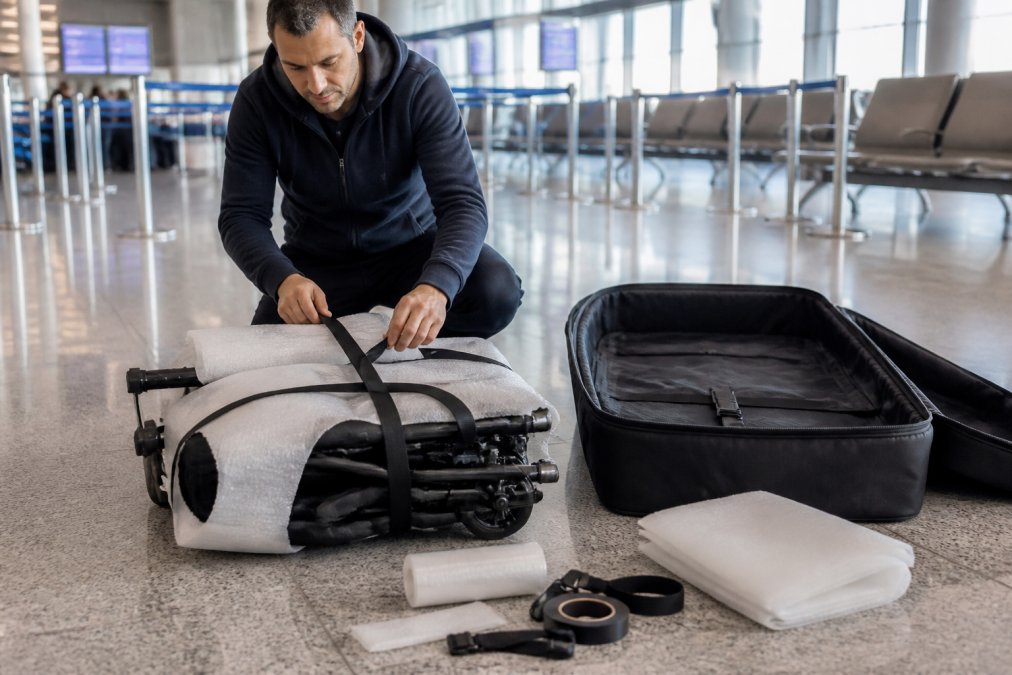
- Remove footrests, armrests, and any detachable cushions
- Fold or collapse the frame according to the manufacturer's instructions
- Wrap the frame and any exposed metal in foam or padded fabric
- Protect the joystick or control unit separately with rigid padding
- Place the wrapped frame into the case and fill empty gaps with soft items
- Secure everything with internal straps so nothing moves when the case is tilted
- Zip, lock, and label the case with your name and contact details
Gate-Check Protocols Airlines Rarely Explain
Gate-checking a mobility aid usually means handing it over at the jet bridge and collecting it there on arrival. What airlines rarely spell out is that gate-checked items still travel in the hold, and they still get handled like cargo.
Airline Approved Mobility Scooter Cases: What to Look For
There is no single universal "airline approved" stamp for scooter cases. Approval is determined by each airline's own size, weight, and battery rules, so the case that clears one carrier may not clear another.
| Feature | Why It Matters | What to Avoid |
|---|---|---|
| Pivoting wheels | Maneuverability through terminals | Fixed wheels that catch on carpet |
| Reinforced handles | Load-bearing at the gate | Thin stitched straps only |
| Rigid joystick pocket | Prevents control damage | Loose padding around controls |
| Water-resistant fabric | Rain on the tarmac | Uncoated cotton or thin nylon |
| Secure zippers | Stays closed in transit | Open-top or velcro closures |
| Weight capacity rating | Matches your equipment | Unrated or vague specs |
Joystick Protection and Interior Padding That Prevents Damage
Joystick protection is the single most overlooked detail in mobility case design. Controls are delicate, expensive, and positioned exactly where a case gets grabbed. Most guides tell you to 'pad the joystick' and stop there. Here is what actually works, and why.
Why the Joystick Fails First
A joystick is a lever on a pivot. Sideways force at the top of the stick translates into torque at the base, where the potentiometer or hall-effect sensor sits. That base is the failure point. Foam wrapped loosely around the stick does almost nothing, because the stick can still deflect inside the foam. What you need is a rigid shell around the base of the control unit, plus a soft layer between that shell and the case wall.
A workable build:
- Cut a foam block (closed-cell polyethylene or EVA, roughly 1-2 inches thick) to fit snugly around the control housing.
- Carve a channel for the stick itself so it cannot bend more than a few degrees.
- Wrap the block in a soft layer, a microfiber towel or thin open-cell foam, to absorb vibration.
- Tape the block closed so it cannot shift, then place the whole assembly in a rigid insert or a hard-sided pocket.
Padding Is Not One Material
Interior padding does two different jobs, and they call for different materials:
- Shock absorption (impact from a drop or a thrown bag) wants open-cell foam, which compresses and rebounds.
- Vibration damping (the constant rumble of a cargo hold) wants a denser, closed-cell layer that does not pack down over a long trip.
The Insurance and Liability Angle Most Guides Skip
If the airline damages your equipment, the padding you built is also your evidence. A documented, well-padded packing job supports a claim that the damage occurred in transit rather than from pre-existing wear. Photograph the packed interior, joystick block, straps, gap fill, before you close the case. Keep the receipt for any foam or insert you buy, since it establishes that you took reasonable protective measures.
DIY Packing Hacks and Insurance for Damaged Equipment
Two things most guides skip: packing hacks that cost nothing, and what happens when the airline damages your equipment anyway.
Portability Features: Wheels, Handles, and Straps That Matter
Portability is where cheap cases show their weaknesses. A lightweight design that sacrifices structure will not survive a hold, and heavy construction that lacks good wheels will wreck your back in the terminal.
Frequently Asked Questions
What type of luggage is best for people in wheelchairs?
Hard shell cases offer the best impact resistance for checked mobility equipment, while soft shell cases with padded interiors work well for carry-on items and folding walkers. Look for water-resistant fabric, reinforced handles, and secure zippers. If you plan to buy portable mobility aid travel cases, match the case to your device's folded dimensions and weight capacity. A case that fits a transport chair won't fit a mobility scooter, so measure before ordering.
What are the TSA requirements for mobility scooters?
TSA allows mobility scooters and wheelchairs through security checkpoints. You'll need to remove the battery if it's a spillable type, though most modern lithium-ion batteries can stay installed if they meet FAA watt-hour limits. Arrive early and tell the screening agent about your device. TSA mobility aid travel guidelines recommend labeling batteries clearly and carrying documentation from the manufacturer. Check with your specific airline too, since gate-check procedures vary.
How do I protect my mobility aid during air travel?
Use a padded travel case with reinforced corners and secure zippers. Remove or cushion the joystick, and detach any parts that could snap. Take photos of your equipment before check-in. Some airlines let you gate-check mobility devices, which reduces handling. For extra protection, consider a hard shell case with shock absorption. Also review your homeowner's or travel insurance policy, since airline liability for damaged mobility equipment is often capped at a low amount.
Are there specific travel cases for electric wheelchairs?
Yes. Look for cases designed with joystick protection, padded interior compartments, and water-resistant fabric like durable nylon or Cordura. These cases typically include reinforced handles and pivoting wheels for maneuverability through airports. Measure your chair's folded dimensions and weight capacity before buying. Airline approved mobility scooter cases often double as storage suitcases at home, which adds value if you travel a few times a year.
Traveling with mobility equipment asks you to plan for the worst handling and hope for the best. Journey Must Haves curates travel essentials built for exactly that gap, from storage sets that keep components contained to gear that protects what matters in transit. Explore our collections and pack with confidence, knowing your equipment is ready for the journey ahead.