

11 Best Travel Accessories for Elderly Mobility in 2026
Table of Contents
- What to Look For in Travel Accessories for Elderly Mobility
- Quick Comparison: Top Picks for Elderly Travelers
- Lightweight Travel Mobility Aids That Make a Real Difference
- Comfortable Travel Accessories for Seniors: Seating and Footwear
- Safety and Stability Gear for Hotel Rooms and Bathrooms
- TSA Travel Tips for Seniors with Limited Mobility
- Which Travel Accessories Should You Pack?
- Frequently Asked Questions
Last Updated: September 9, 2026
What to Look For in Travel Accessories for Elderly Mobility
The best travel accessories for elderly mobility are lightweight, easy to deploy without bending or fumbling, and solve a specific problem rather than adding clutter.
At Journey Must Haves, we curate travel essentials for older adults and caregivers who want independence without sacrificing safety, focusing on practical solutions for real physical limitations.
TL;DR:
- Prioritize accessories under 2 lbs that pack flat and require no tools to set up
- Focus on three zones: mobility support, seated comfort, and bathroom safety
- Test every product at home before your trip, not at the airport
Build your kit around your specific diagnosis, severe arthritis calls for different support than plantar fasciitis or general fatigue, and avoid generic "senior travel" bundles.
Quick Comparison: Top Picks for Elderly Travelers
For most travelers, a balanced kit covers mobility assistance, comfort during long sits, and stability in unfamiliar bathrooms. Here is how the top categories stack up for different needs:
| Accessory | Best For | Weight | Price | Key Feature |
|---|---|---|---|---|
| Foldable walking aids | Gate-to-gate mobility | Under 2 lbs | Varies | Collapsible for overhead bins |
| Memory foam seat cushion | Hip/back pain on flights | ~1.5 lbs | $64.99 | Slow-rebound pressure relief |
| Wide-fit walking shoes | Swollen feet, plantar fasciitis | ~1 lb per shoe | $44.85-$62.15 | Zero-drop, memory foam insole |
| Suction handrail | Hotel bathroom safety | ~1 lb | $31.99 | Tool-free, 70kg capacity |
| GPS tracker | Wandering or disorientation | 7 grams | $24.99 | Real-time location alerts |
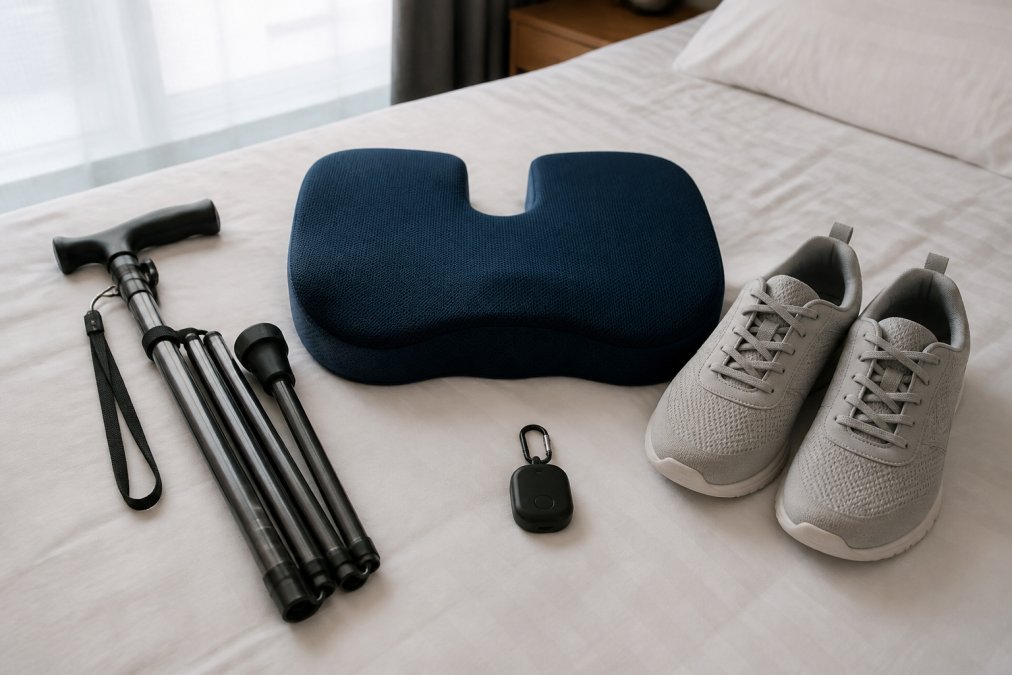
The right combination depends on your itinerary. A direct flight demands less than a layover-heavy one. For a caregiver planning for an elderly parent who tires easily, prioritize seated comfort and bathroom safety. For chronic pain, invest in footwear and orthotic support first.
Lightweight Travel Mobility Aids That Make a Real Difference
The best travel mobility aids fold small enough to fit in a carry-on yet provide genuine support. A foldable walker or travel cane with a wide base offers stability on uneven airport floors, but weight and bulk can become a burden if you are also managing luggage.
Home rollators are heavy, difficult to collapse, and often exceed airline carry-on restrictions. Look for collapsible designs under 5 lbs that fit in overhead bins. For occasional support, a lightweight travel cane with a quad base provides stability without the bulk of a full rollator.
For winter travel, traction is a hidden mobility issue. Ice and wet surfaces turn a simple curb into a fall risk. CDC fall prevention guidance for older adults emphasizes that most falls happen on level surfaces, not stairs. Slip-on shoe grips with hardened steel spikes, like the Ice Claws from Journey Must Haves at $26.99, add security on snow and ice without changing your footwear.
Comfortable Travel Accessories for Seniors: Seating and Footwear
Long flights and extended waits are brutal on arthritic joints and swollen feet. The right seating support and footwear can reduce travel fatigue dramatically, but generic "comfort" products often miss the mark for people with specific conditions.
For hip and back pain, a memory foam seat cushion with a breathable cover makes a measurable difference on hard seats. The Ergonomic Memory Foam Seat Cushion from Journey Must Haves ($64.99) uses slow-rebound foam that contours to your body, and the breathable mesh cover prevents heat buildup.
Shoes that fit in the morning become torture devices by hour six when feet swell. The Ellese & Co. Broadfit Diabetic Footwear ($44.85) uses a zero-drop build with a memory foam insole for swollen feet. The Arch Support Wide Width Walking Sneakers ($62.15) include orthotic insoles and a wide toe box that prevents squeezing that aggravates plantar fasciitis and bunions.

For travelers who prefer to keep their own shoes, orthopedic insoles with 35mm arch height and a deep heel cup, like the new Orthopedic Sport Insoles ($14.05), provide support without replacing your wardrobe; plantar fasciitis therapy wraps ($3.85) offer targeted heel relief during hotel recovery time.
Safety and Stability Gear for Hotel Rooms and Bathrooms
Hotel bathrooms are statistically the most dangerous part of any trip for older adults, slippery tubs and missing or poorly placed grab bars create fall risks you would never accept at home.
The Suction Cup Non-Slip Bathroom Handrail from Journey Must Haves ($31.99) attaches securely to smooth tile or glass without drilling. The textured grip provides stability in wet environments, and the ABS+PP+PVC construction supports up to 70kg.

Beyond the bathroom, consider a portable support handle for getting in and out of bed or low chairs. Hotel beds are often higher or softer than what you are used to at home, and the transition from sitting to standing is a common fall point. A portable handle that slides under the mattress provides use without permanent installation.
TSA Travel Tips for Seniors with Limited Mobility
Navigating airport security is often the most stressful part of travel for older adults, but preparation removes most of the friction. The TSA guidance for travelers with disabilities and medical conditions provides clear procedures for passengers who need assistance or carry medical equipment through screening.
Arrive prepared to explain your mobility aids and medical devices. Collapsible canes, walkers, and wheelchairs are permitted through security, but they must go through the X-ray machine. If you cannot stand unassisted during screening, tell the officer before you reach the conveyor belt. You can request a private screening or a pat-down instead of the walk-through metal detector if either is more comfortable.
Airline Lithium-Ion Battery Policies for Mobility Scooters
This is the single most overlooked detail in senior travel planning. Airlines treat mobility scooters as medical devices, but the battery falls under separate hazardous materials regulations that vary by carrier and battery type.
Wet cell (non-spillable) batteries are the most common type in older scooters. Airlines generally accept them if the battery is clearly marked as non-spillable and the terminals are protected from short circuits. Most carriers require the battery to remain installed in the device, secured upright in the cargo hold.
Sealed lead-acid (SLA) batteries are treated similarly to wet cell batteries. They are permitted when the device is checked at the gate or the ticket counter, provided the battery is securely attached and the unit is protected from accidental activation.
Lithium-ion batteries are where policies diverge sharply. Under FAA rules, spare lithium-ion batteries over 100 watt-hours (Wh) are prohibited in carry-on bags, and batteries over 160 Wh are prohibited entirely unless approved by the airline. Many mobility scooters use batteries in the 150-300 Wh range, which means you must contact the airline in advance, often 48 hours or more, to secure approval. Some carriers cap total lithium-ion battery capacity at 300 Wh per device, while others allow up to 600 Wh with written approval.
What this means for your packing strategy: If your scooter has a removable lithium-ion battery under 160 Wh, some airlines allow it in the cabin, protecting it from cargo damage. If non-removable, request a fragile tag and consider a padded scooter travel cover.
A note on spare batteries for other devices: The FAA limits spare lithium-ion batteries to 100 Wh for carry-on without airline approval, affecting more than scooters, portable oxygen concentrators, CPAP machines, and even high-capacity power banks can exceed this threshold. Check the Wh rating printed on every battery before you pack; if the rating is worn off, replace the battery or leave the device at home.
Keep all prescription medications in original labeled bottles in your carry-on, with a printed list of generic names and dosages. Pack a medication organizer in an easily accessible pocket for security checks or mid-flight access.
Which Travel Accessories Should You Pack?
If traveling with a walker or wheelchair, ask about gate-checking, request a fragile tag, consider a mobility aid travel bag to shield the frame, and carry a basic repair kit with replacement screws and rubber tips.
For most trips, the essential kit breaks down into three layers:
- Mobility essentials: Collapsible cane or walker, shoe grips for wet surfaces, GPS tracker for peace of mind
- Comfort core: Memory foam seat cushion, wide-fit supportive shoes or orthotic insoles, compression socks for long flights
- Safety net: Suction cup bathroom handrail, portable bed support handle, medication organizer, printed medical information
A GPS tracker is underrated for elderly travelers with early-stage cognitive decline or a tendency to wander. The GPS Tracker from Journey Must Haves ($24.99) weighs 7 grams, attaches to a lanyard, and provides real-time location monitoring with a 20-meter wireless range for immediate alerts.
Matching Your Kit to Your Travel Environment
The mistake most guides make is treating a cruise ship the same as a city walking tour. The physical demands, surface conditions, and accessibility infrastructure differ dramatically, and your accessory kit should reflect that.
Cruise ships: The biggest challenge is constant motion and dock gaps. Pack a foldable cane with a wide base for gangways and a rollator with locking wheels for rough seas. Cabin bathrooms on older ships are tight, so a compact suction handrail is essential. Book only accessible tours through the cruise line. Bring a motion sickness band even if you have never needed one.
City walking tours: Cobblestones and uneven sidewalks are the enemy of narrow-wheeled rollators. Opt for a rollator with 8-inch or larger wheels for historic districts. A cane with a quad base provides better stability on uneven surfaces. Carry a portable seat cushion in a daypack for limited seating. For tours over two hours, plan a mid-point break; fatigue compounds silently.
National parks and nature trails: Paved, accessible trails exist in most major parks, but they are often longer than they appear on the map. The National Park Service accessibility information publishes detailed accessibility guides for each park, including surface type, trail grade, and restroom locations. Pack hiking poles with rubber tips for packed gravel paths, and bring a hydration pack or waist bottle, carrying a water bottle in your hand while using a cane or walker is a fall risk. If you use a wheelchair, verify that the park's shuttle system is lift-equipped; many are, but some historic parks still use inaccessible vehicles.
Airports and long layovers: Pre-book wheelchair assistance even if you plan to walk, you can decline it at the gate, but cannot summon it easily if you tire mid-terminal. A lightweight rollator that converts to a seat is invaluable during layovers. Wear slip-on shoes through security and pack your medication organizer in an outer pocket.
Post-travel recovery is the phase most guides ignore. Plan a rest day after arrival, especially for long flights or significant time zone changes. Travel fatigue compounds existing conditions, and pushing through exhaustion on day one often leads to setbacks that shorten the rest of the trip. NIH research on mobility and aging consistently shows that recovery time is not optional for older adults; it is a physiological requirement.
Frequently Asked Questions
What are the best mobility devices for seniors when traveling?
The best mobility devices for travel are lightweight and collapsible. A foldable walker or a travel cane offers support without adding heavy baggage. For longer distances inside airports, consider requesting a wheelchair escort from your airline. These services are free and can be booked in advance. The goal is to preserve energy for your destination, so choose aids that are easy to fold, store, and manage through security checkpoints.
What are the TSA rules for seniors over 70?
Travelers over 75 can keep their shoes and light jackets on during screening, but must still remove items from pockets. Mobility aids like canes, walkers, and rollators must go through the X-ray machine. You can request a private screening or a pat-down if you have medical implants or conditions that make standard screening difficult. Notify a TSA officer about any mobility limitations before the screening process begins.
How can seniors navigate airports with limited mobility?
Request wheelchair assistance when booking your flight or at check-in. This service is free and covers getting through security, to the gate, and on and off the plane. Arrive at the airport at least two hours early for domestic flights to avoid rushing. Use a lightweight travel mobility aid for the parts you want to walk yourself. Keep essential medications and documents in a small bag you can access easily.
What should be included in a senior travel mobility kit?
A well-rounded kit starts with a lightweight mobility aid like a foldable cane or walker. Add comfort items like an ergonomic memory foam seat cushion for long waits and compression socks for flights. Include a portable support handle for hotel bathrooms and a small GPS tracker for peace of mind. For footwear, pack supportive, wide-width shoes to reduce foot fatigue during long walking days.