

Are Ergonomic Travel Cushions Worth Buying?
Table of Contents
- What Ergonomic Travel Cushions Actually Do
- Can You Bring a Seat Cushion on a Plane?
- The Best Ergonomic Seat Cushion for Long Flights: What to Look For
- Do Travel Cushions Help with Neck Strain and Travel Fatigue?
- Seat-Specific Compatibility: Planes, Trains, and Buses
- Durability, Material Safety, and Long-Term Value
- Frequently Asked Questions
Last Updated: September 21, 2026
What Ergonomic Travel Cushions Actually Do
Ergonomic travel cushions are portable support pads designed to hold your head, neck, or hips in a neutral position during long periods of sitting. They reduce the muscle strain that builds when your body fights gravity for hours.
Support Structures: Memory Foam, Inflatable, and Microbead
Memory foam molds to your shape and holds it. Inflatable cushions pack down to almost nothing but feel firmer and less forgiving. Microbead fills shift as you move, which some travelers love and others find unstable.
Wrap-Around vs. U-Shape: Which Design Fits Your Trip
U-shape cushions rest on your shoulders and support the head from both sides. Wrap-around designs fasten at the front, which stops your head from flopping forward when you sleep.
Can You Bring a Seat Cushion on a Plane?
Yes. The Transportation Security Administration allows seat cushions in carry-on and checked baggage, and they are not counted as a separate personal item by most airlines.
A few practical notes:
- Inflatable cushions deflate in seconds and slide into a daypack
- Memory foam cushions are bulkier but need no inflation
- Wrap-around styles often clip to your bag handle
The Best Ergonomic Seat Cushion for Long Flights: What to Look For
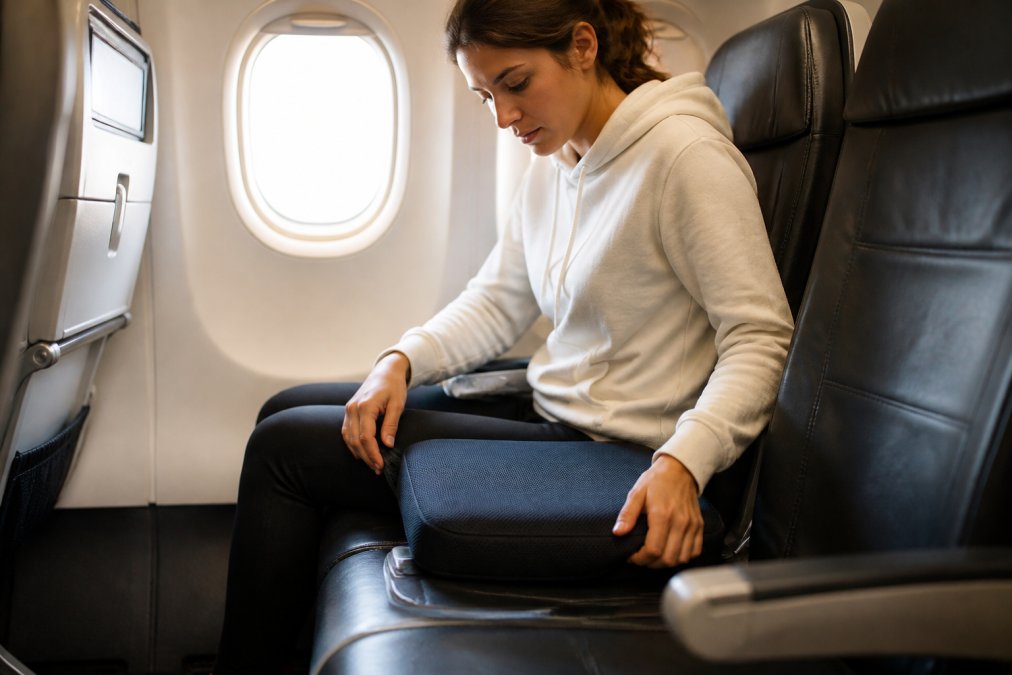
The best ergonomic seat cushion for long flights balances three things: support, packability, and breathability. Get all three right and you will actually use it. Get one wrong and it stays in your closet.

Weight, Size, and Packability
Memory foam cushions are heavier and take up real space. If you travel carry-on only, measure before you buy. Inflatable options compress to the size of a water bottle, which matters on multi-leg trips.
Breathability and Material Comfort
Breathable fabric covers let air move against your skin. A mesh cover helps here. Fleece covers feel softer but run warmer, which becomes uncomfortable on a long-haul flight.
Do Travel Cushions Help with Neck Strain and Travel Fatigue?
They help, but only when the cushion matches the problem. Neck strain comes from unsupported head weight. Travel fatigue comes from poor posture over hours.
| Problem | What Helps | What Doesn't |
|---|---|---|
| Stiff neck | Wrap-around support | Loose U-shape |
| Lower back ache | Lumbar support | Neck-only cushion |
| Overheating | Mesh or breathable cover | Fleece cover |
| Bulky packing | Inflatable design | Rigid foam block |
Seat-Specific Compatibility: Planes, Trains, and Buses
Most guides treat "planes, trains, and buses" as three interchangeable rows in a table. They are not. What actually determines whether a cushion works is the geometry of the seat you are sitting in, specifically the headrest, the recline range, and the seat pitch. Get those three wrong and even a well-reviewed cushion becomes dead weight in your bag.
Airplane seats: headrest adjustability is the deciding factor
Airplane seats fall into three rough categories, and each one changes which cushion design makes sense:
- Fixed, non-adjustable headrests. Common on older narrow-body cabins and many short-haul configurations. The headrest is a molded shell with no vertical travel and no side wings. A wrap-around cushion has nothing to anchor against, so it tends to slide down behind your neck. A U-shape with a rear strap that loops over the top of the seatback holds better here.
- Adjustable headrests with side wings. Standard on most long-haul economy cabins. The wings fold forward and the headrest slides up. These seats are the best case for a wrap-around cushion, because the wings give the cushion something to brace against and the strap can cinch under the chin without fighting the seatback.
- Lie-flat and angled-flat business seats. The headrest is often shallow or recessed into the shell. A thick memory foam collar can push your chin toward your chest in the flat position, which is the opposite of what you want. A thin, low-profile wrap or a small lumbar wedge works better here.
Train seats: wider, flatter, and often headrest-friendly
Most intercity train seats have a wider back, a taller fixed headrest, and more recline travel than an economy airline seat. That extra width means a standard U-shape cushion often sits too loose to do anything. A wider wrap-around or a cushion with an adjustable rear strap fits the taller headrest better.
Bus seats: firm support wins, soft support fails
Bus seats vary more than any other mode, from thin vinyl benches on commuter routes to padded recliners on long-distance coaches. The common failure mode is a soft microbead or low-density foam cushion that compresses flat under a heavier recline angle and stops supporting anything. On buses, prioritize firmer foam and a strap that grips a tall seatback.
The compatibility check to run before you buy
Before you spend money, answer these three questions about the seats you actually sit in most:
- Does the headrest adjust up and down, or is it fixed?
- Does it have side wings that fold forward?
- How much recline travel does the seat have?
Durability, Material Safety, and Long-Term Value
Most articles answer "is it worth buying" with a price-per-trip calculation and stop there. That math is real, but it skips the two questions that actually decide long-term value: does the cushion still support your neck after a year, and is the material safe to breathe against your face for hours at a time.
The orthopedic mechanism: what "support" actually means
A travel cushion earns its place only if it holds your cervical spine in roughly neutral alignment, ears over shoulders, chin neither tucked nor lifted. When you fall asleep sitting up, your neck muscles relax and your head drops forward, which loads the posterior cervical muscles and the upper trapezius. That is the stiff neck you feel on landing.
Foam density: the number that predicts whether it lasts
Memory foam is graded by density, usually expressed in pounds per cubic foot. Low-density foam feels soft in the store and flattens within months of regular use. Higher-density foam holds its shape far longer but feels firmer and weighs more. If a product page does not list density, that is itself a signal, most reputable foam suppliers publish it, and most budget cushions do not.
Off-gassing and material safety
New memory foam commonly releases volatile organic compounds (VOCs) for the first days to weeks after unboxing. That "new foam" smell is the off-gassing. For most people it fades and is not a health concern, but for anyone sensitive to chemical odors, or using the cushion against their face on a long flight, it is worth taking seriously.
What to do about it:
- Unbox the cushion and let it air out in a well-ventilated room for several days before your first trip.
- Look for foams marketed as low-VOC or certified to a recognized indoor-air standard. Certifications vary, so read what the specific claim covers rather than trusting a logo.
- Choose a cover you can remove and wash. A removable, washable cover does more for long-term hygiene than any fabric treatment.
- Check for recalls before buying. Consumer Product Safety Commission recall database is the authoritative starting point.
Durability: what actually fails first
In practice, three things fail on a travel cushion, in this order:
- The foam. Low-density foam loses loft and stops supporting. This is the most common failure and the hardest to fix.
- The zipper and strap hardware. Thin plastic clips snap; cheap zippers separate. These are usually replaceable or repairable.
- The cover. Pilling, stretched seams, and fading are cosmetic but shorten usable life if the cover is not replaceable.
The value math, done honestly
Divide the purchase price by the number of trips you will realistically take it on. A cushion used on ten trips a year for three years is thirty uses. A cushion that lives in a closet is zero uses, no matter how good the reviews were.
Frequently Asked Questions
Are ergonomic travel cushions effective for chronic back pain?
They can reduce pressure on your lower spine during long periods of sitting, but they are not a treatment for chronic conditions. A memory foam cushion with an ergonomic design supports posture alignment and weight distribution, which may ease discomfort on a long-haul flight. If you have a diagnosed back condition, check with your doctor before relying on any cushion. Many travelers with arthritis or chronic pain find that a supportive cushion makes sitting more tolerable, but results vary by individual and seat type.
Can you bring a seat cushion on a plane?
Yes, you can bring a seat cushion on a plane. The TSA does not restrict personal cushions in carry-on or checked baggage. Most airlines treat them as personal items, so they count toward your carry-on allowance rather than your main bag. Inflatable cushions pack down small and fit easily in a backpack. Memory foam cushions take up more space but typically fit under the seat in front of you. Check your airline's specific carry-on policy before you fly.
Do ergonomic cushions actually help with long-haul flight fatigue?
They help by keeping your spine and neck in a neutral position, which reduces the muscle strain that builds up over hours of sitting. A cushion with cervical support and adjustable strap keeps your head from flopping forward during sleep, cutting down on the stiff neck and shoulder tension that makes you feel drained after landing. The cushion does not replace movement. Stand up, stretch, and walk the aisle when you can. The combination of support and movement is what keeps travel fatigue manageable.
What should I look for when buying an ergonomic travel cushion?
Focus on four things: support structure, material, portability, and seat fit. Memory foam gives slow rebound and comfortable support. Look for a breathable fabric cover to enhance air circulation. Check the dimensions against your typical seat. A cushion that is too bulky will not fit in a coach seat, and one that is too thin will not provide enough cushioning for a long-haul flight.
Travel discomfort is not something you have to accept on every long trip. The right cushion solves the problem that cheap airport pillows never do. Journey Must Haves curates travel essentials built for real physical needs, including the Ergonomic Memory Foam Seat Cushion with its breathable mesh cover and slow-rebound support. Explore Our Collections and find gear that keeps you moving comfortably.