

Accessible Travel Essentials for Caregivers: 2026 Guide
Table of Contents
- Accessible Travel Essentials for Caregivers: What to Pack First
- How to Request Airport Wheelchair Assistance
- The Caregiver Travel Checklist: Documents, Meds, and Backup Plans
- Choosing Accessible Accommodations and Getting Around
- Managing Medications and Medical Equipment in Transit
- Budgeting for Accessibility Without Overspending
- Caregiver Burnout During Travel: Warning Signs and Respite Strategies
- Post-Trip Recovery and Debriefing for Caregivers
- Frequently Asked Questions
Last Updated: September 15, 2026
Accessible Travel Essentials for Caregivers: What to Pack First
Accessible travel essentials for caregivers are the items that keep a trip safe and manageable when you are responsible for someone else's mobility, medication, or comfort. This guide from Journey Must Haves covers the gear, paperwork, and backup plans that matter most. The single most important rule: pack for the problem you have actually encountered before, not the one you imagine.
Gear That Solves Real Problems on the Road
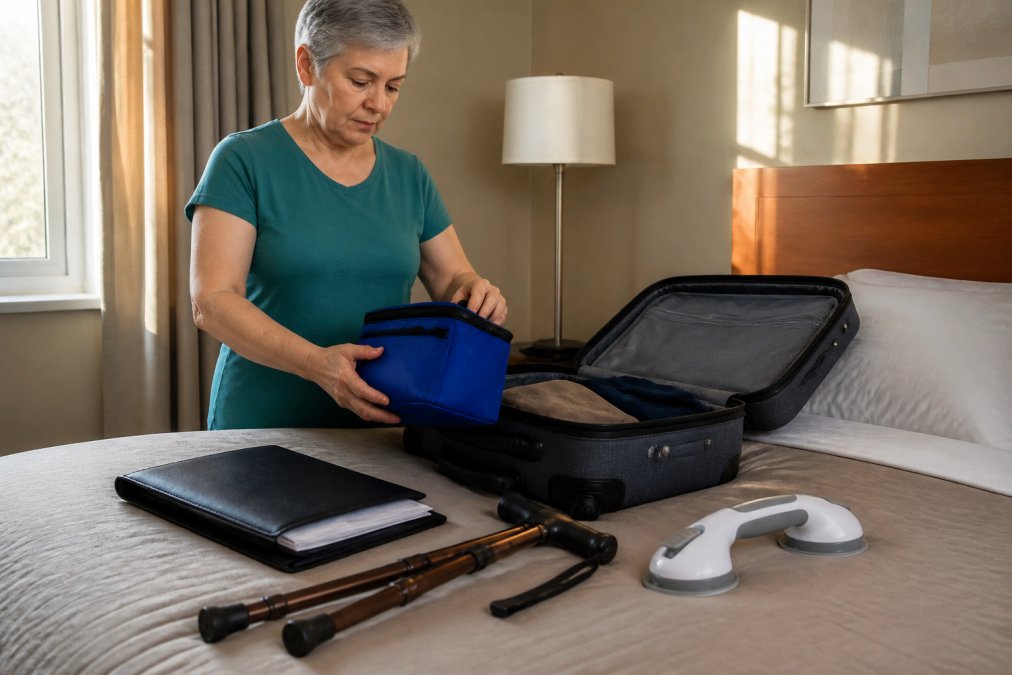
The most useful items replace a task you would otherwise do with your hands and your back. A caregiver pushing a wheelchair and carrying two bags has no spare hand, so anything that clips, folds, or suctions onto something else earns its place.
Three categories cover most trips:
- Transfer and stability aids. A suction cup non-slip bathroom handrail attaches to smooth tile without drilling, which matters in hotels that forbid modifications. It supports up to 70kg and gives your travel companion something to grip during a shower transfer (Fig. 37 Grab Bars at Shower Stalls).
- Footwear and foot support. Swollen feet are common after long flights and long days. Broadfit diabetic footwear uses a zero-drop build and memory foam insole, and orthopedic sport insoles add arch support for anyone covering more ground than usual.
- Medication temperature control. A portable insulin and medication cooler bag holds temperature-sensitive medication for 36+ hours without power, which covers a long-haul flight plus the drive to the hotel.
How to Request Airport Wheelchair Assistance
Request wheelchair assistance when you book the ticket, then reconfirm it 48 hours before departure and again at check-in. Airlines must provide this service at no charge under the Air Carrier Access Act, enforced by the U.S. Department of Transportation (transportation.gov). Requesting it early means staff and equipment are assigned before you arrive.


What to Say at the Gate and What to Confirm in Writing
At the gate, state three things: the type of assistance needed, whether your companion can transfer independently, and whether the wheelchair is their own or the airline's. Ask for written or app-based confirmation so you have a record if the service does not appear.
- Booking: Request "wheelchair assistance to and from the aircraft" and specify aisle chair if needed.
- 48 hours out: Call the airline and confirm the request is attached to the reservation.
- Check-in: Ask the agent to print or display the assistance confirmation.
- Gate: Confirm the arrival airport has the same request logged.
The Caregiver Travel Checklist: Documents, Meds, and Backup Plans
A caregiver travel checklist is a single printed document you can hand to a stranger in an emergency. Keep one copy in your carry-on and one with your companion, a dead phone battery is not an emergency plan.
- Photo ID and medical insurance cards for both of you
- Medication list with generic names, dosages, and prescribing doctor
- Written medical documentation for mobility equipment and any injectables
- Emergency contact information, including the treating physician
- Copies of flight, hotel, and transfer bookings
- A one-page summary of your companion's communication needs and routines
Choosing Accessible Accommodations and Getting Around
Accessible accommodations are not a single standard. "Wheelchair accessible" can mean a step-free entrance and nothing else. The properties that get it right are the ones where you asked the right questions before you booked.
The Measurements That Actually Matter
When you call the property, ask for numbers, not adjectives. A room that works for a wheelchair user typically needs:
Ground Transportation: Book, Don't Hail
Ask two questions of any accessible transport provider:
Digital Tools That Cut the Guesswork
When the Room Falls Short
Managing Medications and Medical Equipment in Transit
Temperature: How Long Cooler Bags Actually Hold
Documentation: What TSA and the Airline Actually Want
Devices: CPAP, Spare Batteries, and Mobility Equipment
Daylight: The Buffer Rule
Budgeting for Accessibility Without Overspending
Build your budget in three tiers:
| Tier | What It Covers | Where to Save |
|---|---|---|
| Essential | Accessible room, medical documentation, medication cooling | Book early; accessible rooms are limited |
| Practical | Portable transfer aids, insoles, backup mobility equipment | Buy once, reuse across trips |
| Comfort | Upgraded seating, extra night buffers, respite care | Trim here first |
Spend on the items that prevent an injury or a missed connection. Save on the items that only make the trip nicer.
Caregiver Burnout During Travel: Warning Signs and Respite Strategies
Post-Trip Recovery and Debriefing for Caregivers
Frequently Asked Questions
What are the 10 essential travel items for caregivers?
A solid accessible travel kit includes: a medication cooler bag, a printed caregiver travel checklist, medical documentation and insurance cards, a portable ramp or transfer aid, a suction cup grab bar for hotel bathrooms, orthopedic insoles or supportive footwear, a backup phone charger, emergency contact information, a small first-aid kit, and a foldable walking stick or cane. The Portable Insulin & Medication Cooler Bag keeps temperature-sensitive meds cool for 36+ hours without power, which covers long travel days.
How do I request airport wheelchair assistance effectively?
Request wheelchair assistance when you book your ticket, then call the airline 48 to 72 hours before departure to confirm. At the airport, go to the airline's special assistance desk and ask for a 'gate-to-gate' or 'curb-to-seat' service. Keep a copy of your request confirmation. Under the Air Carrier Access Act, airlines must provide this service at no extra charge. Confirm the return leg too, since requests sometimes only apply to the outbound flight.
What documentation should caregivers carry when traveling?
Carry the traveler's medical insurance cards, a signed letter from the doctor listing diagnoses, medications, and any medical devices, plus prescription copies with generic drug names. If the traveler has a disability badge or parking permit, bring it. For mobility aids, keep a photo of the serial number in case of damage. Put a one-page medical summary in your carry-on and a second copy in the checked luggage. This helps at security, customs, and any medical emergency.
How can caregivers manage medication and medical supplies on the go?
Pack medication in carry-on, never checked luggage. Use a cooler bag for insulin or other refrigerated drugs, and bring twice the amount you expect to need. Keep medications in original labeled containers to avoid issues at security. For CPAP equipment or other devices, check the airline's medical device clearance rules before flying. Set phone alarms for doses, and note the local time zone shift. A caregiver travel checklist with medication times prevents missed doses during busy travel days.
What gear is necessary for traveling with a loved one with mobility challenges?
The most useful items are a portable ramp for curbs and small steps, a suction cup grab bar for hotel showers, supportive footwear like diabetic shoes, and a lightweight transfer belt. A Suction Cup Non-Slip Bathroom Handrail ($31.99) installs without tools on smooth surfaces and supports up to 70kg, which helps with balance in unfamiliar bathrooms. Add orthopedic insoles for long walking days and a foldable cane that fits in a carry-on.
How can caregivers avoid burnout during a trip?
Schedule daily downtime for yourself, even 20 minutes. Split care tasks with a travel companion if possible. Use respite services at your destination, such as a hotel sitter or local home care agency. Watch for warning signs: irritability, exhaustion, or feeling resentful. Build one low-effort activity into each day, like a coffee break alone. After the trip, plan a recovery day before returning to normal responsibilities. Caregiver burnout is common but manageable with pre-trip planning.
Accessible travel asks caregivers to solve logistics, medical needs, and their own exhaustion at the same time. Journey Must Haves curates gear built for exactly these constraints, from the 36-hour medication cooler bag to the suction cup handrail that installs without tools. Explore our collections and pack for the trip you are actually taking.